Showing posts with label endurance swims. Show all posts

Jun 30, 2014

Barrington resident Don Macdonald does not call himself an adrenaline junkie, but rather more of an adventurer – who has learned the art of restraint.

Macdonald, 52, previously swam the length of Tampa Bay, the Boston Harbor, Lake Zurich, Lake Michigan, off the coast of California’s Seal Beach and Manhattan Beach, and in the La Hoya Cove off the coast of San Diego.


Reprinted: Barrington Courier Bridget O'Shea
“I think water gives me a sense of freedom, but it’s a very quiet, lonely freedom,” said McDonald, noting that he has sometimes shared this freedom with jellyfish, dolphins and sea lions.
However, a different type of challenge presented itself to MacDonald in 2011, when he began to experience cardiac issues after returning from a trip overseas, where he planned to swim the English Channel but was unable to due to weather conditions.
While taking a break from swimming, MacDonald began experiencing shoulder, arm and chest pain, which he said he was not too worried about.
“When you’re training 10K a day for swimming, your body is going to ache,” he said.
However, it turned out that MacDonald did have mild heart issues. After seeing his doctor, who then referred him to a cardiologist, MacDonald was treated with stents for narrowed arteries, given a typical medication regimen and stress tests. He was later approved to begin training again for the English Channel.
“During that time, I was actually out jogging and I had a major cardiac arrhythmia event that put me in the hospital for 10 days,” he said. “I was standing at a block party after I ran and I collapsed. This kind of came out of the blue, which is why it was so challenging to wrap my head around.”
Luckily, a retired nurse was at the party and began resuscitating him.
“She saved my life,” he said.
MacDonald was taken to Advocate Good Shepherd Hospital, where cardiologists implanted a small defibrillator device just beneath his skin to detect any abnormalities and reset electrical impulses.
“It’s been challenging physically and emotionally,” said MacDonald, who was used to training by swimming up to 26 miles at a time in 50-degree water.
But instead of focusing on any setbacks, MacDonald is now using his experience as an example of the importance of proper health screenings and evaluations for open water swimmers, triathletes and others that engage in vigorous sports.
“People have to pay attention to what they are doing to their bodies,” he said. “Everybody needs to consider their health situation carefully. Here’s a guy who could swim the English Channel and look what happened to me.”
Particularly with high endurance sports, MacDonald said, a feeling of being indestructible can sometimes develop, leading to a false sense of security. He uses himself as an example.
“Before this, it had gotten to the point where I was no longer afraid to swim in any body of water regardless of seals, sharks or the temperature of the water,” he said. “The biggest thing is that you go from being able to do anything and everything to, ‘OK, what do I do now?’”
Since his 2011 stay at Good Shepherd, MacDonald has reached out to the community, working with high schools, middle schools and the District 220 Educational Foundation by speaking to young people as a living example of the importance of cardiac and other medical tests and screenings for athletes.
While less vigorous exercise is now part of his recovery, MacDonald, who has swum since he was a young child, has not lost his love for the water.
On June 28, he will kayak the perimeter of Manhattan Island in New York as his friend Doug McConnell swims in the Manhattan Island
Marathon Swim.
“Instead of curling up and being the wilting flower, I decided that instead of swimming every day, I would do kayaking,” he said.
MacDonald will kayak next to a 9-foot boat with food, water and medical supplies for the swimmers. His main objective, he said, is the safety of his friend.
MacDonald has kayaking experience, most notably the 28 miles from Catalina Island to Los Angeles, a ride that began in the middle of the night.
“It was pitch black,” he said. “You could hear dolphins and whales.”
Originally from Goshen, Ind., MacDonald said he moved to Barrington from Chicago about 15 years ago and he and his wife enjoy raising their daughter here.
“It’s a great community,” he said, describing Barrington as a place where you can go to the city, go horseback riding or go into town for ice cream.
“It truly has everything you want from a small town,” he said. “It’s kind of the quintessential experience.”

Apr 3, 2013

Healthy Nutrition - What 2000 Calories Looks Like

Heart healthy nutrition for athletes (of any age) is a subject often not spoken about at the family dinner table, the team locker room, or often by coaches until you reach perhaps the elite level and even then selectively or at best incorrectly.  

Coupled with ninja marketing campaigns from babyhood ranging from outright miss-information to subliminal marketing, these messages cross the airwaves and internet bombarding our kids, teens and families. 


So for starters lets begin with some basics:

Jan 26, 2013

Cold-water swims - Rewards, Risks, and Your Health

Cold Water Swimming and Your Health?


Doug McConnell & Don Macdonald taking a dip in sub 60f Lake Zurich early March

What that means is that cold-water swimmers probably aren't any better protected from the elements than anyone else. Plus, at least in the Bay Area, most of them aren't elite-level athletes either. But something about them makes them better able to tolerate and
overcome the cold.

It's a commonly held belief, by swimmers and landlubbers alike, that an extra layer of fat insulates regular bay swimmers from the deep chill of the water. But Nuckton, a fairly trim swimmer himself, wasn't so sure the tourist was right.


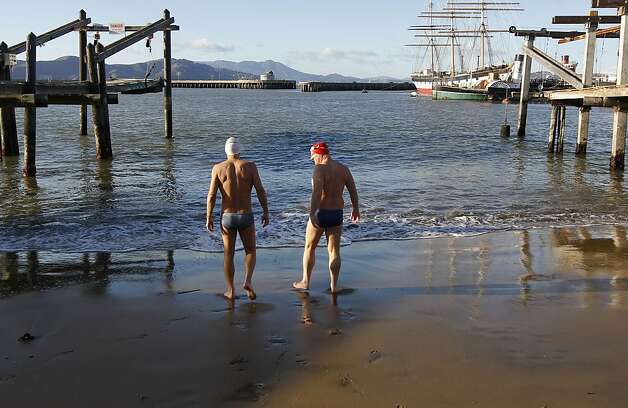
Steve Schatz (left) and Dr. Thomas Nuckton prepare for an afternoon swim off San Francisco's Aquatic Park last week. Both men are members of the Dolphin Club, which encourages swimming without wet suits. Photo: Michael Macor, The Chronicle
Last week, the Bay Area was quivering through a cold snap, and the tourists along Fisherman's Wharf were, for once, dressed for the weather, bundled in jackets and scarves, mittens and caps.
Down at Aquatic Park, Dr. Thomas Nuckton was stripped to his swimsuit and neck deep in 50-degree bay water. And he wasn't alone. Winter is the time of year that the truly devoted - or truly crazy - swimmers come out, those hardy folk who dive nearly naked into San Francisco Bay, into waters 25 or 30 degrees colder than the average swimming pool. The health benefits of these swims are debatable, the risks less so. And yet every year, dozens, maybe a hundred, people swim all through the winter months, putting in miles and hours in the water. "People will go down there to swim, and it's almost like a spiritual experience," Nuckton said. "It's not quite the same for me. I hate getting in the water," he added with a laugh. "But I have my good days. And I'd much rather be there than in a pool, staring at a black line and just going back and forth." Nuckton is a doctor at UCSF and California Pacific Medical Center, focused primarily on studying survival prognoses for patients in intensive care wards. But he's taken a side interest in swimming and, in particular, the effects of cold-water dips.

Last month, after a yearlong study of people in his swimming club, Nuckton was able to show that these swimmers are, in fact, just about the same size as the average American. Crazier, maybe. But not fatter.

"All of these factors probably come into play," Nuckton said. "How good is your engine in terms of generating heat? How cold is the water and how long are you going to spend in it?"

Schatz (left) and Nuckton brave the bay waters. Nuckton, a physician, has been studying his fellow cold-water swimmers. Photo: Michael Macor, The Chronicle
Aided by extra fat? More fit, but why? Risks overstated Peril of sudden shock

Nuckton's most recent study was prompted by a comment he overheard from a tourist standing on the Hyde Street Pier, watching the Aquatic Park swimmers. "He pointed at the swimmers and said, 'They're fatter than us. That's how they endure the cold,' " Nuckton recalled.

There is no doubt, doctors say, that regular cold-water swimmers are healthier overall than most Americans. But whether it's the cold or the simple act of regular exercise that helps them is unclear.

Over the past decade, Nuckton has made a hobby of studying the members of his swim group, the Dolphin Club. Along with the South End Rowing Club, the Dolphin Club encourages no-wet-suit swimming in the bay. The clubs' members host several group events year-round, including a New Year's Day swim from Alcatraz to Aquatic Park, and they operate hot showers and saunas for post-swim recovery.

"I'm not convinced that, physiologically speaking, cold-water swimming helps. I think these people are already healthy to begin with and they want to challenge their bodies," said Dr. Malini Singh, medical director of emergency medicine at San Francisco General HospitalThere are theories, but not much evidence, about how cold water can improve health. Some studies have shown that people who swim through the winter have higher immune cell counts than nonswimmers. And some scientists, and swimmers, have speculated that cold-water swimming increases production of what's known as brown fat, thought to be a healthy fat that burns energy and creates heat. Many cold-water swimmers believe they're burning more calories in the bay as their bodies struggle to stay warm than they would in a heated pool, but scientists aren't convinced that's the case. Cold water, in fact, slows the metabolism, which may mean that the body is actually burning fewer calories. Even if there is a larger calorie burn, it's probably negligible, doctors say.

It's not just the benefits of cold-water swimming that are tough to document. The risks are poorly understood and probably overstated too, some doctors said. Two studies of athletes competing in long-distance, open-water swims found that most of them were suffering mild hypothermia by the end of the race, even when the water temperatures were in the 60s or higher. "I know people do it. Anecdotally speaking, they say they feel refreshed, they feel less stress and less fatigue," she added. "But I've been in that water, in a wet suit, and I just felt terribly cold to my bones." Nuckton studied 11 participants in a 2000 Alcatraz swim and found that five were suffering mild hypothermia by the end of the event. And perhaps more concerning, their temperatures continued to drop after they got out of the water. But mild hypothermia on its own is not necessarily a dangerous thing. In Nuckton's study, most swimmers' temperatures dropped about 2 degrees below normal, which probably wouldn't produce any noticeable symptoms or discomfort. In order for hypothermia to cause major damage or become deadly, the body temperature needs to drop to the low 90s.

The concern with hypothermia is twofold. First, that someone may experience early symptoms of it and become sluggish or disoriented, which could be deadly when a swimmer is in deep water and has trouble making it safely back to land. And second, some older or less fit swimmers may not be as well adapted to handling the cold as their younger or more experienced peers.
"The important thing is, I wouldn't be doing this for the first time, just jumping right in, if you're elderly or have significant medical issues," said Dr. Joel Levis, assistant chief for the emergency department at Kaiser Santa Clara. "Those people are better off just swimming in a pool."

Aside from hypothermia, there is a small risk associated with the sudden shock of jumping into cold water. Anyone who has dived into frigid water knows the feeling - the heart rate soars, breathing becomes erratic, and it usually takes a minute or two to calm down. That's rarely a problem, but there have been a handful of cases of people suffering heart attacks and subsequently drowning from that initial shock.
And then there's the native aquatic life. For the most part, swimmers exist companionably with the critters, but several years ago a rogue sea lion bit dozens of people in Aquatic Park, requiring a few of them to get stitches and antibiotics.
But on the whole, a swimmer is probably more likely to be injured by someone doing a sloppy butterfly stroke at the pool than by, say, a great white shark in the open water.
"The chances of getting eaten by a shark are pretty low. You just don't think about it," said Robin Rose, an Aptos resident who swims regularly in Santa Cruz, usually doing a mile around the wharf several times a week.

Rose started open-water swimming in 2009, and she swam regularly even through treatment for breast cancer in 2010. She wears a wet suit for now - but she's seriously considering joining the "skin" swimmers sometime in the near future.
"I went to Aquatic Park, just to try it, and it actually felt really good," Rose said. "I was only in for about five minutes, and it was so cold, but it was so invigorating. There's nothing else like it."

Article Reprinted from: Erin Allday is a San Francisco Chronicle staff writer. E-mail: eallday@sfchronicle.com

Dec 15, 2009

10,000 for Fun

Decided that an early winter endurance test of my training might be fun and something different to see how both physical as well as the mental training (i.e. spending long periods of time going back and forth in a pool) are shaping up. Decided to try the 100 x 100 yards (10,000 yards or 5.6 miles) race at the Latoff Chicago YMCA on December 27th. I figure it should take me a little over three hours at a relaxed pace of 1:30 per. This should be simple for the first 50-60 but later as the mind begins to tire I suspect it will become a little harder, but thats the point, work on the mental toughness since 400 laps.

Training otherwise keeps plugging along at 20k yards this past week.  Adding weights has gotten my shoulders sore but working through it. Last night at practice we did a whole workout in sweat shirts. I brought along my trusty old heavy duty Indiana sweatshirt (what the hell was I thinking??). Needless to say I felt like a drowning rat but managed to keep going through 4000 yards (2+ miles). for awhile I thought i was back in Goshen swimming a "Rathke" practice with Steve Conder in lane 1?