Showing posts with label good Shepard health care. Show all posts

May 30, 2014

Barrington man takes on ‘Triple Crown’ challenge with swim around Manhattan

Don Macdonald Kayak's alongside Doug McConnell here pictured in the middle of the pacific ocean between Catalina Island and mainland California in 2013.

With Doug's swim, the third leg of the Triple Crown bearing down in several weeks, we have been focused on extending training time in open water. While Doug has the Yeoman's work in the water this time, Im in the kayak again, and support crew in the boat. Both exposed to the weather (what ever condition it is) for 9-10 hours. 

The biggest concern we have for Doug is safety. The rivers around New York Harbor are very congested and dangerous with large ocean going ships, ferries - docking, embarking at all hours. These ships also generate sizable waves that multiply both in height and length bouncing off sea walls causing both kayaker and swimmer tremendous stress to stay on course. 

The other challenge are the piers. These are not your standard piers but large loading docks, commercial businesses extending into the river sometimes 100 plus yards disrupting the flow of water, swirling ebbs, causing the kayaker and swimmer direction problems and immediate danger from a collision. 

"There's no room for error, the current never stops and at 2-4 MPH, you will get dragged into a pier pole, debris, or ship very easily", said Don Macdonald who recently went on a test run while in New York. 

As a marathon swimmer myself, I know its essential for me to remain focused on all aspects of Doug's safety but not outwardly show the slightest change in my tempo, direction and even mood as things happen. And they always do. 

As these swims progress, its not uncommon for swimmers to become depressed from the solitude of the effort coupled with the physical exhaustion. As the reach 6-8 hours mark, the swimmer hits "the wall" both physically and mentally. The slightest perception of stress can be detected from the swimmer, stress from changes to direction, hitting some debris floating in the water, swallowing some polluted water ... can weigh heavily on the swimmers mental outlook. 

For both of us, this will be another test of resilience, forged in the desire of pushing oneself to help others. 
Sometimes your simply alone


Article Reprinted from Sun Times
As harsh, cold and seemingly unending as the winter was, few were clamoring to take long dips in area lakes as of mid-May.
Doug McConnell, however, already was swimming about 20 miles a week, often in lakes registering thermometer readings in the 50s and 60s, including Lake Michigan.
No, he wasn’t wearing a wetsuit. And no, he’s not crazy. He’s on a mission.
On June 28, the 56-year-old will attempt what is known in marathon swimming circles as the MIMS, the Manhattan Island Marathon Swim. Swimming long distances in breathtakingly, bone-achingly cold lakes is all part of the training.
McConnell, of Barrington, already swam across the English and Catalina channels. Only the MIMS — a 28.5-mile swim around Manhattan through the Hudson and Harlem rivers — stands between McConnell and the Triple Crown of open water swimming. If he makes it, he’ll join just more than a dozen others who have completed all three while over the age of 50.
Perhaps equally as remarkable, through a fundraising organization he started with his swimming friend and fellow Barrington resident Don Macdonald, McConnell has turned pulling and kicking his way through waves into more than $225,000 for the Les Turner ALS Foundation.
Amyotrophic lateral sclerosis, also known as Lou Gehrig’s disease, claimed the life of McConnell’s father, David, in 2006. Another of his relatives now battles ALS.
“It’s just dreadful,” McConnell said of the disease, which affects nerve cells in the brain and spinal cord. “It’s a slow motion shipwreck. To watch anybody you love go through that, to see them just go to pieces like that, it’s hard to watch.”
Proceeds from McConnell’s organization, A Long Swim, go to the Les Turner ALS Laboratory to advance treatments and find a cure. Researchers are making great strides, McConnell said.
“It’s a pretty gratifying and exciting time to be supporting research into a disease that has frustrated so many for such a long time,” he said. “There are drug trials going on. There are new discoveries about upper motor neurons.”
Dr. P. Hande Ozdinler is director of the Les Turner ALS Laboratory and an assistant professor in the Department of Neurology at the Feinberg School of Medicine at Northwestern University.
Support received through McConnell and A Long Swim has been vital, Ozdinler said. With it, Ozdinler developed a method of making corticospinal motor neurons fluorescent. The labeling makes it easier for doctors to discover what goes wrong in patients with ALS and other motor neuron-affecting diseases.
Because of the headway that’s been made, the National Institutes of Health has granted $3 million to further studies at the lab, Ozdinler said.
“Before we got the NIH money, the only support was from the Les Turner Foundation, which depends heavily on people like Doug,” Ozdinler said. “His efforts make a difference.”
McConnell, meanwhile, is focused on ensuring that his body is well-prepared for the MIMS. Though he swims throughout the year at Foglia YMCA, recent conditioning has meant 6 a.m. loops around Lake Zurich and adventures in Lake Michigan, as well.
“It’s just such a lift to be outside in the sunshine,” he said. “The water’s been cold, but boy oh boy, to be out there and watch the sun come up, it’s just fabulous.”
McConnell expects to encounter chilly waters in New York, which “had the same crazy winter we did,” he said.
“The only way to get acclimated to cold water is to spend a lot of time in cold water,” McConnell continued. “It can be unpleasant and so forth, but the acclimation really works.”
McConnell noted that hypothermia is not a condition to be taken lightly. His swims are monitored. The crew often includes his wife, Susan, and their four children, ranging in age from 16 to 26. Macdonald also typically is there, riding alongside in a kayak.
The Manhattan Island Marathon Swim will start at Battery Park, with a view of the Statue of Liberty in the harbor. Twenty-three swimmers are signed up to participate on June 28, McConnell said. Others are swimming June 14 and July 12.
Start time is 7:20 a.m. Central time.
“They time it carefully around an incoming tide,” McConnell said. “It’s what pushes you north up the East River. You swim on the East River to about 120th or 130th Street, and then you cut left. You take the Harlem River northwest and swim that to 210th Street.
“That’s where the Harlem dumps into the Hudson, and you take that back to Battery Park,” he said. “This is 28.5 miles. However, because of the tidal push on the East River and the downstream ride on the Hudson, most people do it in eight or nine hours. It swims more like 17 or 18 miles rather than 28.
“That, of course, is all dependent upon the day and how well you’re able to hook into the currents.”
McConnell said he looks forward to the event, which also is a race. He crossed the English Channel — a feat that included 25-knot winds and 5-foot waves as well as pitch-black darkness — in 14 hours and 18 minutes. The Catalina Channel took 12 hours, 41 minutes.
McConnell said that turning a personal goal into a charitable endeavor adds to his motivation.
The response from both corporations and individuals has been tremendous. Minneapolis-based Medtronic is among his sponsors. The company makes medical devices, including the PRESTIGE disc, one of which was implanted in McConnell’s spine in 2009.
“From individuals, we had some $5 donations and one that was $5,000. The message and the disease really resonate with people,” McConnell said. “Many of the donations were from good friends of my father’s. I have another family member battling with ALS now, and a lot of old friends of hers are donating.”
Anyone interested in learning more or donating is encouraged to visit alongswim.com.
“The funding that [McConnell] received has turned into something really big and really good,” Northwestern’s Ozdinler said. “Without him and the support of the foundation, I don’t think we would have been able to generate the tools we have today.”

Mar 10, 2013

Stressed kids eat even when they’re full - Lack of Resilience ?


For all you One Stroke at a Time readers, This insightful article touches on some points parents might consider for resilience building skills for yourself and your kids. 
It suggests one of the factors driving obese kids could be a lack of underlying social and emotional resilience, leading to an inability to properly cope with and manage day-to-day life stress's, eating not for fuel but for comfort. I suppose many of us parents could learn from this as well with the side benefit of heart healthy living. Enjoy the commentary...


PENN STATE / JOHNS HOPKINS (US) — Children who overreact to stressful situations will eat even if they’re not hungry, raising their risk of becoming overweight or obese, a new study shows.
Children whose cortisol levels stayed high after being exposed to a stressor had the highest BMIs and consumed the greatest number of calories in the absence of hunger. (Credit:iStockphoto)
“Our results suggest that some children who are at risk of becoming obese can be identified by their biological response to a stressor,” says Lori Francis, associate professor of biobehavioral health at Penn State. “Ultimately, the goal is to help children manage stress in ways that promote health and reduce the risks associated with an over- or under-reactive stress response.”
For a new study published in the journal Appetite, Francis and her colleagues, Elizabeth Susman, professor of biobehavioral health, and Douglas Granger, director of the Center for Interdisciplinary Salivary Bioscience Research at Johns Hopkins University, recruited 43 children ages 5- to 9-years-old and their parents.

Straight from the Source

DOI: 10.1016/j.appet.2012.11.008
To examine the children’s reactions to a stressor, the team used the Trier Social Stress Test for Children, which consists of a five-minute anticipation period followed by a 10-minute stress period.
During the stress period, the children were asked to deliver a speech and perform a mathematics task. The team measured the children’s responses to these stressors by comparing the cortisol content of their saliva before and after the procedure.
The researchers also measured the extent to which the children ate after saying they were not hungry using a protocol known as the Free Access Procedure. The team provided the children with lunch, asked them to indicate their hunger level and then gave them free access to generous portions of 10 snack foods, along with a variety of toys and activities. The children were told they could play or eat while the researchers were out of the room.
The team found that, on average, the children consumed 250 kilocalories of the snack foods during the Free Access Procedure, with some consuming small amounts (20 kilocalories) and others consuming large amounts (700 kilocalories).
“We found that older kids, ages 8 to 11, who exhibited greater cortisol release over the course of the procedure had significantly higher body-mass indices [BMI] and consumed significantly more calories in the absence of hunger than kids whose cortisol levels rose only slightly in response to the stressor,” Francis says.
“We also found that kids whose cortisol levels stayed high—in other words, they had low recovery—had the highest BMIs and consumed the greatest number of calories in the absence of hunger.”
The study suggests that children who have poor responses to stressors already are or are at risk of becoming overweight or obese. In her future work, she plans to examine whether children who live in chronically stressful environments are more susceptible to eating in the absence of hunger and, thus, becoming overweight or obese, Francis says.
“It is possible that such factors as living in poverty, in violent environments, or in homes where food is not always available may increase eating in the absence of hunger and, therefore, increase children’s risk of becoming obese.”
The Children, Youth and Families Consortium at Penn State and the National Institutes of Health provided funding for this research.
Source: Penn State

Jan 26, 2013

Cold-water swims - Rewards, Risks, and Your Health

Cold Water Swimming and Your Health?


Doug McConnell & Don Macdonald taking a dip in sub 60f Lake Zurich early March

What that means is that cold-water swimmers probably aren't any better protected from the elements than anyone else. Plus, at least in the Bay Area, most of them aren't elite-level athletes either. But something about them makes them better able to tolerate and
overcome the cold.

It's a commonly held belief, by swimmers and landlubbers alike, that an extra layer of fat insulates regular bay swimmers from the deep chill of the water. But Nuckton, a fairly trim swimmer himself, wasn't so sure the tourist was right.


Steve Schatz (left) and Dr. Thomas Nuckton prepare for an afternoon swim off San Francisco's Aquatic Park last week. Both men are members of the Dolphin Club, which encourages swimming without wet suits. Photo: Michael Macor, The Chronicle
Last week, the Bay Area was quivering through a cold snap, and the tourists along Fisherman's Wharf were, for once, dressed for the weather, bundled in jackets and scarves, mittens and caps.
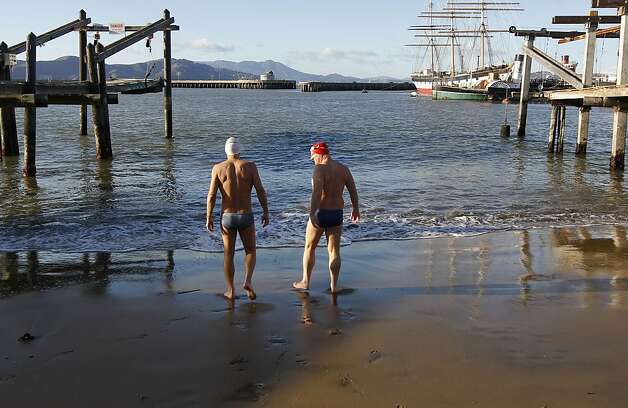
Down at Aquatic Park, Dr. Thomas Nuckton was stripped to his swimsuit and neck deep in 50-degree bay water. And he wasn't alone. Winter is the time of year that the truly devoted - or truly crazy - swimmers come out, those hardy folk who dive nearly naked into San Francisco Bay, into waters 25 or 30 degrees colder than the average swimming pool. The health benefits of these swims are debatable, the risks less so. And yet every year, dozens, maybe a hundred, people swim all through the winter months, putting in miles and hours in the water. "People will go down there to swim, and it's almost like a spiritual experience," Nuckton said. "It's not quite the same for me. I hate getting in the water," he added with a laugh. "But I have my good days. And I'd much rather be there than in a pool, staring at a black line and just going back and forth." Nuckton is a doctor at UCSF and California Pacific Medical Center, focused primarily on studying survival prognoses for patients in intensive care wards. But he's taken a side interest in swimming and, in particular, the effects of cold-water dips.

Last month, after a yearlong study of people in his swimming club, Nuckton was able to show that these swimmers are, in fact, just about the same size as the average American. Crazier, maybe. But not fatter.

"All of these factors probably come into play," Nuckton said. "How good is your engine in terms of generating heat? How cold is the water and how long are you going to spend in it?"

Schatz (left) and Nuckton brave the bay waters. Nuckton, a physician, has been studying his fellow cold-water swimmers. Photo: Michael Macor, The Chronicle
Aided by extra fat? More fit, but why? Risks overstated Peril of sudden shock

Nuckton's most recent study was prompted by a comment he overheard from a tourist standing on the Hyde Street Pier, watching the Aquatic Park swimmers. "He pointed at the swimmers and said, 'They're fatter than us. That's how they endure the cold,' " Nuckton recalled.

There is no doubt, doctors say, that regular cold-water swimmers are healthier overall than most Americans. But whether it's the cold or the simple act of regular exercise that helps them is unclear.

Over the past decade, Nuckton has made a hobby of studying the members of his swim group, the Dolphin Club. Along with the South End Rowing Club, the Dolphin Club encourages no-wet-suit swimming in the bay. The clubs' members host several group events year-round, including a New Year's Day swim from Alcatraz to Aquatic Park, and they operate hot showers and saunas for post-swim recovery.

"I'm not convinced that, physiologically speaking, cold-water swimming helps. I think these people are already healthy to begin with and they want to challenge their bodies," said Dr. Malini Singh, medical director of emergency medicine at San Francisco General HospitalThere are theories, but not much evidence, about how cold water can improve health. Some studies have shown that people who swim through the winter have higher immune cell counts than nonswimmers. And some scientists, and swimmers, have speculated that cold-water swimming increases production of what's known as brown fat, thought to be a healthy fat that burns energy and creates heat. Many cold-water swimmers believe they're burning more calories in the bay as their bodies struggle to stay warm than they would in a heated pool, but scientists aren't convinced that's the case. Cold water, in fact, slows the metabolism, which may mean that the body is actually burning fewer calories. Even if there is a larger calorie burn, it's probably negligible, doctors say.

It's not just the benefits of cold-water swimming that are tough to document. The risks are poorly understood and probably overstated too, some doctors said. Two studies of athletes competing in long-distance, open-water swims found that most of them were suffering mild hypothermia by the end of the race, even when the water temperatures were in the 60s or higher. "I know people do it. Anecdotally speaking, they say they feel refreshed, they feel less stress and less fatigue," she added. "But I've been in that water, in a wet suit, and I just felt terribly cold to my bones." Nuckton studied 11 participants in a 2000 Alcatraz swim and found that five were suffering mild hypothermia by the end of the event. And perhaps more concerning, their temperatures continued to drop after they got out of the water. But mild hypothermia on its own is not necessarily a dangerous thing. In Nuckton's study, most swimmers' temperatures dropped about 2 degrees below normal, which probably wouldn't produce any noticeable symptoms or discomfort. In order for hypothermia to cause major damage or become deadly, the body temperature needs to drop to the low 90s.

The concern with hypothermia is twofold. First, that someone may experience early symptoms of it and become sluggish or disoriented, which could be deadly when a swimmer is in deep water and has trouble making it safely back to land. And second, some older or less fit swimmers may not be as well adapted to handling the cold as their younger or more experienced peers.
"The important thing is, I wouldn't be doing this for the first time, just jumping right in, if you're elderly or have significant medical issues," said Dr. Joel Levis, assistant chief for the emergency department at Kaiser Santa Clara. "Those people are better off just swimming in a pool."

Aside from hypothermia, there is a small risk associated with the sudden shock of jumping into cold water. Anyone who has dived into frigid water knows the feeling - the heart rate soars, breathing becomes erratic, and it usually takes a minute or two to calm down. That's rarely a problem, but there have been a handful of cases of people suffering heart attacks and subsequently drowning from that initial shock.
And then there's the native aquatic life. For the most part, swimmers exist companionably with the critters, but several years ago a rogue sea lion bit dozens of people in Aquatic Park, requiring a few of them to get stitches and antibiotics.
But on the whole, a swimmer is probably more likely to be injured by someone doing a sloppy butterfly stroke at the pool than by, say, a great white shark in the open water.
"The chances of getting eaten by a shark are pretty low. You just don't think about it," said Robin Rose, an Aptos resident who swims regularly in Santa Cruz, usually doing a mile around the wharf several times a week.

Rose started open-water swimming in 2009, and she swam regularly even through treatment for breast cancer in 2010. She wears a wet suit for now - but she's seriously considering joining the "skin" swimmers sometime in the near future.
"I went to Aquatic Park, just to try it, and it actually felt really good," Rose said. "I was only in for about five minutes, and it was so cold, but it was so invigorating. There's nothing else like it."

Article Reprinted from: Erin Allday is a San Francisco Chronicle staff writer. E-mail: eallday@sfchronicle.com

Dec 2, 2012


DSC02316


7 Days | 7 Stages | 120 miles
I have decided to set a personal goal for myself for 2013 to be over 50 and attempt this dynamic test of one resilience for 7 days, swimming under 7 bridges, covering some 120 flow assisted miles through some of the most scenic countryside America has to offer. Dave Barra and a team of volunteers started this a few years ago to bring awareness to the water quality of the river among other important issues. David and I first met in the Boston Light House Marathon swim two years ago while both were training for the English Channel. 

In the intervening year I have faced some challenges to my health, receiving cardiac stints, 7 months ago. Lets consider for a moment the fact that this was a complete surprise, a marathon swimmer in great shape, able to swim in low 50's degree water for hours under punishing conditions. What I didn't appreciate was that genetically I was susceptible to arterial plaque build-up.  I have begun training (slowly) and lifting weights to re-build my conditioning and strength so as I transition to 5 day weeks of swimming my body will adjust. Because of the medications I am now on (Statins and cardiac rate limiting drugs for protective measures) I have new challenges. How to fuel myself during training and the event with healthy foods that are high energy (not just bulk glycogen carbo's) and re-teaching my muscles to acclimate to lower available oxygen from Beta Blockers that force the heart rate to stay below 120 and affect endurance.

I look to this event, which is current assisted but still no cake walk by any means, to have a goal, re-focus my training but more importantly my mental game to overcome the naturally built in 'doubts' one gets from such a surprise cardiac event. I will have many tests between now and then under the supervision of my medical team. 

458627_495232473827130_547720399_o
From the peaceful Catskills to the dramatic Narrows, at the throat of the New York Harbor, intrepid swimmers cover 120 miles of the Hudson River's great stream. The 8 Bridges Hudson River Swim, the longest marathon swim in the world, is an epic swimming odyssey that celebrates the mighty Hudson and New York Harbor. For one week, each day's marathon swim begins with the ebb tide at one bridge and ends at the next, covering distances ranging from 13.2 miles to 19.8 miles. Swimmers can participate in one to all of the seven stages. The swim strings together the Rip Van Winkle | Kingston-Rhinecliff | Mid-Hudson | Newburgh-Beacon | Bear Mountain | Tappan Zee | George Washington | Verrazano Narrows Bridges.

June 15 to June 22, 2013.


Stage 1. Rip Van Winkle to Kingston Rhinecliff


Date: Saturday June 15, 2013
Rain Date: Sunday June 16, 2013
Splash Time: 8:20 am
Distance: 18.3 miles
Highlights: Cementon, Saugerties Lighthouse, small islands, mostly narrow, meandering, and rural.
Stage Record: 4hr:31m
Recommended Pace over 3 hours: 30 mins per mile
Water Temp.: 68 – 74˚F
Stage Map

Stage 2. Kingston Rhinecliff Bridge to Mid-Hudson Bridge


Date: Sunday June 16, 2013
Rain Date: Monday June 17, 2012
Splash Time: 8:00 am
Distance: 19.8 miles
Highlights: Roundout lighthouse, Esopus Meadows lighthouse, mostly narrow, meandering, and rural.
Stage Record: 5hr:28m
Recommended Pace over 3 hours: 28 mins per mile
Water Temp.: 68 – 74˚F
Stage Map
Stage 3. Mid-Hudson Bridge to Newburgh Beacon Bridge


Date: Monday June 17, 2013
Rain Date: Tuesday June 18, 2013
Splash Time: 8:40 am
Distance: 13.2 miles
Highlights: Cedar Cliff, Danskammer, New Hamburg, Chelsea.
Stage Record: 3hr:42m
Recommended Pace over 3 hours: 37 mins per mile
Water Temp.: 68 – 74˚F
Stage Map
Stage 4. Newburgh Beacon Bridge to Bear Mountain Bridge


Date: Tuesday June 18, 2013
Rain Date: Wednesday June 19, 2012
Splash Time: 9:00 am
Distance: 15.0 miles
Highlights: Hudson Highlands, Bannermans Castle, Break Neck, Storm King, Sugarloaf, West Point, The Devil’s Playground, Anthony’s Nose.
Stage Record: 4hr:10m
Recommended Pace over 3 hours: 30 mins per mile
Water Temp.: 68 – 74˚F
Stage Map
Stage 5. Bear Mountain Bridge to Tappan Zee Bridge


Date: Thursday June 20, 2013
Rain Date: Friday June 21, 2013
Splash Time: 8:25 am
Distance: 19.8 miles
Highlights: Indian Point, Haverstraw Bay, Hook Mt., narrow, meandering and also very open.
Stage Record: 6hr:05m
Recommended Pace over 3 hours: 27 mins per mile
Water Temp.: 68 – 73˚F
Stage Map
Stage 6. Tappan Zee Bridge to George Washington Bridge


Date: Friday June 21, 2013
Rain Date: Saturday June 22, 2013
Splash Time: 10:30 am
Distance: 15.7 miles
Highlights: Piermont Marsh, Pallisades, Yonkers, Spuyten Duyvil
Stage Record: 3hr:28m
Recommended Pace over 3 hours: 44 mins per mile
Water Temp.: 67 – 71˚F
Stage Map
Stage 7. George Washington Bridge to Verrazano Narrows Bridge


Date: Saturday June 22, 2013
Rain Date: Sunday June 23, 2013
Splash Time: 7:40 am
Distance: 18.6 miles
Highlights: Manhattan, Governor’s Island, Statue of Liberty, NY Harbor
Stage Record: 4hr:21m
Recommended Pace over 3 hours: 33 mins per mile
Water Temp.: 67 – 71˚F
Stage Map
Photos by Mario Burger