Showing posts with label CUSD 220. Show all posts

May 30, 2014

Barrington man takes on ‘Triple Crown’ challenge with swim around Manhattan

Don Macdonald Kayak's alongside Doug McConnell here pictured in the middle of the pacific ocean between Catalina Island and mainland California in 2013.

With Doug's swim, the third leg of the Triple Crown bearing down in several weeks, we have been focused on extending training time in open water. While Doug has the Yeoman's work in the water this time, Im in the kayak again, and support crew in the boat. Both exposed to the weather (what ever condition it is) for 9-10 hours. 

The biggest concern we have for Doug is safety. The rivers around New York Harbor are very congested and dangerous with large ocean going ships, ferries - docking, embarking at all hours. These ships also generate sizable waves that multiply both in height and length bouncing off sea walls causing both kayaker and swimmer tremendous stress to stay on course. 

The other challenge are the piers. These are not your standard piers but large loading docks, commercial businesses extending into the river sometimes 100 plus yards disrupting the flow of water, swirling ebbs, causing the kayaker and swimmer direction problems and immediate danger from a collision. 

"There's no room for error, the current never stops and at 2-4 MPH, you will get dragged into a pier pole, debris, or ship very easily", said Don Macdonald who recently went on a test run while in New York. 

As a marathon swimmer myself, I know its essential for me to remain focused on all aspects of Doug's safety but not outwardly show the slightest change in my tempo, direction and even mood as things happen. And they always do. 

As these swims progress, its not uncommon for swimmers to become depressed from the solitude of the effort coupled with the physical exhaustion. As the reach 6-8 hours mark, the swimmer hits "the wall" both physically and mentally. The slightest perception of stress can be detected from the swimmer, stress from changes to direction, hitting some debris floating in the water, swallowing some polluted water ... can weigh heavily on the swimmers mental outlook. 

For both of us, this will be another test of resilience, forged in the desire of pushing oneself to help others. 
Sometimes your simply alone


Article Reprinted from Sun Times
As harsh, cold and seemingly unending as the winter was, few were clamoring to take long dips in area lakes as of mid-May.
Doug McConnell, however, already was swimming about 20 miles a week, often in lakes registering thermometer readings in the 50s and 60s, including Lake Michigan.
No, he wasn’t wearing a wetsuit. And no, he’s not crazy. He’s on a mission.
On June 28, the 56-year-old will attempt what is known in marathon swimming circles as the MIMS, the Manhattan Island Marathon Swim. Swimming long distances in breathtakingly, bone-achingly cold lakes is all part of the training.
McConnell, of Barrington, already swam across the English and Catalina channels. Only the MIMS — a 28.5-mile swim around Manhattan through the Hudson and Harlem rivers — stands between McConnell and the Triple Crown of open water swimming. If he makes it, he’ll join just more than a dozen others who have completed all three while over the age of 50.
Perhaps equally as remarkable, through a fundraising organization he started with his swimming friend and fellow Barrington resident Don Macdonald, McConnell has turned pulling and kicking his way through waves into more than $225,000 for the Les Turner ALS Foundation.
Amyotrophic lateral sclerosis, also known as Lou Gehrig’s disease, claimed the life of McConnell’s father, David, in 2006. Another of his relatives now battles ALS.
“It’s just dreadful,” McConnell said of the disease, which affects nerve cells in the brain and spinal cord. “It’s a slow motion shipwreck. To watch anybody you love go through that, to see them just go to pieces like that, it’s hard to watch.”
Proceeds from McConnell’s organization, A Long Swim, go to the Les Turner ALS Laboratory to advance treatments and find a cure. Researchers are making great strides, McConnell said.
“It’s a pretty gratifying and exciting time to be supporting research into a disease that has frustrated so many for such a long time,” he said. “There are drug trials going on. There are new discoveries about upper motor neurons.”
Dr. P. Hande Ozdinler is director of the Les Turner ALS Laboratory and an assistant professor in the Department of Neurology at the Feinberg School of Medicine at Northwestern University.
Support received through McConnell and A Long Swim has been vital, Ozdinler said. With it, Ozdinler developed a method of making corticospinal motor neurons fluorescent. The labeling makes it easier for doctors to discover what goes wrong in patients with ALS and other motor neuron-affecting diseases.
Because of the headway that’s been made, the National Institutes of Health has granted $3 million to further studies at the lab, Ozdinler said.
“Before we got the NIH money, the only support was from the Les Turner Foundation, which depends heavily on people like Doug,” Ozdinler said. “His efforts make a difference.”
McConnell, meanwhile, is focused on ensuring that his body is well-prepared for the MIMS. Though he swims throughout the year at Foglia YMCA, recent conditioning has meant 6 a.m. loops around Lake Zurich and adventures in Lake Michigan, as well.
“It’s just such a lift to be outside in the sunshine,” he said. “The water’s been cold, but boy oh boy, to be out there and watch the sun come up, it’s just fabulous.”
McConnell expects to encounter chilly waters in New York, which “had the same crazy winter we did,” he said.
“The only way to get acclimated to cold water is to spend a lot of time in cold water,” McConnell continued. “It can be unpleasant and so forth, but the acclimation really works.”
McConnell noted that hypothermia is not a condition to be taken lightly. His swims are monitored. The crew often includes his wife, Susan, and their four children, ranging in age from 16 to 26. Macdonald also typically is there, riding alongside in a kayak.
The Manhattan Island Marathon Swim will start at Battery Park, with a view of the Statue of Liberty in the harbor. Twenty-three swimmers are signed up to participate on June 28, McConnell said. Others are swimming June 14 and July 12.
Start time is 7:20 a.m. Central time.
“They time it carefully around an incoming tide,” McConnell said. “It’s what pushes you north up the East River. You swim on the East River to about 120th or 130th Street, and then you cut left. You take the Harlem River northwest and swim that to 210th Street.
“That’s where the Harlem dumps into the Hudson, and you take that back to Battery Park,” he said. “This is 28.5 miles. However, because of the tidal push on the East River and the downstream ride on the Hudson, most people do it in eight or nine hours. It swims more like 17 or 18 miles rather than 28.
“That, of course, is all dependent upon the day and how well you’re able to hook into the currents.”
McConnell said he looks forward to the event, which also is a race. He crossed the English Channel — a feat that included 25-knot winds and 5-foot waves as well as pitch-black darkness — in 14 hours and 18 minutes. The Catalina Channel took 12 hours, 41 minutes.
McConnell said that turning a personal goal into a charitable endeavor adds to his motivation.
The response from both corporations and individuals has been tremendous. Minneapolis-based Medtronic is among his sponsors. The company makes medical devices, including the PRESTIGE disc, one of which was implanted in McConnell’s spine in 2009.
“From individuals, we had some $5 donations and one that was $5,000. The message and the disease really resonate with people,” McConnell said. “Many of the donations were from good friends of my father’s. I have another family member battling with ALS now, and a lot of old friends of hers are donating.”
Anyone interested in learning more or donating is encouraged to visit alongswim.com.
“The funding that [McConnell] received has turned into something really big and really good,” Northwestern’s Ozdinler said. “Without him and the support of the foundation, I don’t think we would have been able to generate the tools we have today.”

Oct 10, 2012

Nutrition: How Food And Clothing Size Labels Affect What We Eat And What We Wear

I found this analysis and commentary rather insightful recently as I asked for a grilled chicken sandwich and to my surprise found a monster gulp size drink being handed to me. I politely said you have got to be kidding, thats why Americans are exploding in size and dying from all sorts of diseases related to processed foods and huge servings. So take this article re-print for whats its worth and perhaps consider next time size really does matter...


When you go into a restaurant, you probably give some thought to whether you're ordering a small, regular or large sandwich.
That makes sense.With widening waistlines across the land, many of us want to make a health-conscious choice. But are we really getting a small portion when we order a small sandwich?
There's no industry standard size for food and drink portions, so it's hard to compare a Big Gulp with a McDonald's medium soda.
Article from H. Thompson & S. Vedantam
Well, that depends.
University of Michigan marketing professor Aradhna Krishna has studied how labels impact how much we eat. In one experiment, she gave people cookies that were labeled either medium or large, and then measured how much they ate.
 
The catch? The cookies were identical in size.

"Just because there's a different size label attached to the same actual quantity of food, people eat more. But also, [they] think they've not eaten as much," says Krishna.
What happened? You guessed it. People ate more cookies when they were labeled "medium." Rather than trust what their stomachs were telling them, in other words, people went by the label.
Krishna said the psychological principle at work has big ramifications because a 32-ounce soda at McDonald's is called a large soda, but the same drink at Wendy's is called a medium. A small coffee is 10 ounces at Dunkin' Donuts and 12 ounces at Caribou Coffee. When you trust labels, you could end up eating and drinking a lot more than you thought. Check out some visuals over at fastfoodmarketing.org.
Most Americans, moreover, don't realize the "large" soda they order today is about six times as large as the same soda 60 years ago, according to the Centers for Disease Control and Prevention.
"Across the U.S., again what has happened is that food sizes have become larger over time," says Krishna. "So, that same hamburger has become bigger, the french fries have become bigger, and again this is leading to obesity."
Restaurants today can label food and drink as they please. But given the power of labels in shaping behavior, Krishna said that standardizing portion sizes across restaurants could have a bigger impact on public health than New York City's controversial recent ban on all sodas larger than 16 ounces at restaurants and other eateries.
"We're not talking about restrictions in terms of freedom in any way," she said. "All I'm saying is that sizes should be made more uniform, and that will only help the consumer because you'll know what you're getting."
Sticking labels on menus isn't the only way to influence what people eat. As we've reported before, eating off a smaller platecan cause people to overestimate the serving size they've received — and eat less. Drinking beer from a straight glass, rather than a curved one, makes people drink more slowly and better gauge how much they've had to drink.
Krishna said the phenomenon of labels' influencing consumer behavior isn't unique to food. So-called vanity sizing is rampant in the clothing industry. Marketers are relabeling large-size clothes as small to give customers the satisfaction of feeling that they still fit into small-size clothing.
"What used to be a size 8 in the 1950s has become a size 4 in the 1970s and a zero in 2006," Krishna said.
The New York Times


In another study, Krishna and her colleagues found that vanity sizing improved people's body image. Labels shape our experiences in both positive and negative ways.
Referring to different bust sizes among women in Asian countries and in the United States, Krishna argued that people often don't have control over their body size and shouldn't need to feel blame or shame for not conforming to society's ideals. "It's not a question of being lied to," she said. "It's a question of do you want to be lied to."
I guess I better just keep swimming...One Stroke At A Time

Aug 21, 2012

Athletes Back to School Nutrition


Dear Friends,

As we send our kids back to school (especially our young athletes) its important to remember nutrition from natural sources, less supplementation and removing processed foods that are high in fat, triglycerides and cholesterol's.


Here is a great article from Swim Science that applies to all sports, including softball, football and even cheer leading:

Back to school nutrition is one of many changes swimmers face as they head back to school. In this post we’ll discuss some important considerations for keeping young swimmers optimally fueled during the school year.  It’s ironic that coaches will plan workouts down to the second, rely on high tech video cameras to correct strokes,  we’ll remove hair from the entire body to save hundredths of a second during championships, yet nutrition is often an unregulated free-for-all.    

Meal Timing
Does anyone see the irony of athletes (all ages) boasting of their dedication to train twice a day for 5-6 hours, yet they can’t devote ten minutes to preparing a halfway decent breakfast?  Swimmers partially get a pass here due to getting up long before dawn, but preparing a smoothie or finding something moderately nutritious still takes less time than the drive through at McDonald's!

Although breakfast is generally accepted as important, there’s surprisingly little research formalizing its value in youth athletes.  That said, commonsense indicates the importance of a stable blood sugar throughout the day, plus the need for adequate calorie intake. Better to fuel more regularly during the by including breakfast, rather than make up for calorie deficit later in the day (or run a chronic deficit).  Preparation for afternoon practice starts the moment you wake up.

Despite the obesity epidemic in the general population, young swimmers often have difficulty consuming adequate nutrients.  Not only may chronic malnourishment result in poor performance, it may also result in poor health and increased rehab time.  Nothing is more frustrating to athletes of any age than to do all the right things for prevention and rehab of musculoskeletal injuries only to make no progress.  Sometimes injuries are more than just muscles, tendons, ligaments, and bones.

Studies have shown that poor nutrition, especially in female athletes, is significantly correlated with musculoskeletal injury (Reinking 2006, Rauh 2010).  Though we might surmise that ground contact might cause most injuries in terrestrial sports, the latter study (Rauh 2010)did include swimmers.  Authors did not find a statistically significant relationship of any particular sport driving the overall results.  The exact mechanism behind the nutrition/injury connection is unclear (lack of nutrients,persistence of inflammation, hormonal stress are three possible areas), but it is clear that better nutrition can have protective and recuperative effects in young swimmers.

Hydration
Energy drinks often augment or replace meals, especially during the school year.  It’s a quick and easy solution when morning homeroom starts a mere thirty minutes after the last set ends in the pool.  Kids (and adults) don’t get enough sleep which can lead to lasting fatigue when coupled with training hard and having a heavy load at school,.  Woe to the kid that misses intervals in practice but tries to blame last night’s science project and last week’s midterms for slow swimming.  What’s the quick and easy solution…


One thorny area is the distinction between energy drinks and sports drinks.  Though sports drinks (Gatorade, Powerade, etc) are generally deemed safe and effective for young swimmers, energy drinks(Red Bull, Rockstar) are still uncertain. Because they are so new, there simply isn’t much non-company sponsored research on young athletes on which to evaluate their safety.  Still, sports drinks aren’t entirely risk free due to their high calorie and sugar content.  As for energy drinks, the American Council of Sports Medicine (2010) notes,

“Using energy drinks instead of sports drinks for rehydration can result in ingestion of potentially large amounts of caffeine or other stimulant substances and the adverse effects previously described. Of additional concern is the intentional use of energy drinks by adolescents who desire stimulant effects to combat fatigue and increase energy during sports and school activities.”

Supplements vs. Real Food
We adults, as a whole, do a poor job of providing kids with optimal nutrition choices, and ironically the situation doesn’timprove at sporting venues.  In one study from Australia, “Parents reported that their child's most frequently purchased food and beverage items at outdoor sports fields were water, chocolate and confectionery, soft drink and sports drinks, and ice cream. At community swimming pools the most frequently purchased items were ice cream, followed buy snack foods, including chips, cakes and biscuits.” (Kelly 2008)

Kids end up supplementing because they don’t have the basics in the first place, leading to more involvement with supplements than is necessary.  The school year is a ripe time for supplementation as it offers an easy shortcut around meals.  However, lack of quality nutrition is not the only reason for supplementation (“because the pros do it” is another reason…). 

“A major concern for health professionals and the sporting community is that the effects of supplement use on the growth and development of children and adolescents are unclear. Minimal experimental research exists regarding the performance enhancing qualities or adverse effects of ergogenic substances focusing exclusively on adolescent athletes under the age of 18. Many physiological changes are occurring during these developmental stages thus making it difficult to fully understand the physiological implications of regular consumption of supplements by this age group.” (McDowell 2007)

In sum, ssupplements occupy a relatively lawless frontier.  Whereas food recommendations are highly regulated (whether you agree with all of them is a different matter), the supplement industry often operates outside the realm of normal oversight.   No matter what the time constraints, do your best to obtain your young athletes’ nutrition from real foods.  

Conclusion
Despite these warnings, I do recognize the importance of practicality: It’s entirely unrealistic to wake up to sauteed egg whites with meat from the local butcher and buckwheat pancakes with maple syrup you harvested in your backyard, accompanied by a fruit potpourri from the farmer’s market.  An instant breakfast shake is sometimes the best a kid can do, but we still must be aware of the pitfalls in meal timing, hydration, and use of supplements.  Avoid the pitfalls in theseareas to ensure you don’t thwart your kids’ efforts in the pool. 

Feb 9, 2012

Swimming - Life's Little lessons


Three-years-old and frozen at the edge of the pool, I’m counting one, two, two and a half, two and three-quarters and then three. ‘Whoosh’ I yell to my parents as I jump in the water. I had just taken my first stroke in a long journey to swim the english Channel.

Now in junior high, an adolescent struggling in school, my parents enroll me in clubs and sports so I may do well, build self-esteem, and become resilient. at 4’11” I learn basketball and football are not for me, that I am too slow for track, that choir and band are oK, and somehow, I find my way back to water.
Many successes and failures behind me, I am sitting in a familiar place after two and a half years of training, at the edge of a body of water – this time – the english Channel. Thousands of miles swum under every conceivable condition - freez- ing 60 degree fahrenheit water, jellyfish, darkness, sharks, huge waves, spinal damage, and even fam- ily tribulations only a parent appreciates. every detail planned. I am prepared.

I find myself facing a familiar challenge ... one, two, three ... but this time, it’s bad weather turn- ing minutes into hours, hours into days. I grow increasingly anxious, hope fading as wind and rain sweeps ‘la Manche’. a full week passes and my opportunity to swim the english Channel this season fades away. I am crushed.


While we most often think of resiliency as a virtue that helps us react to challenges and disappointments, it also proactively supports our lives. Before leaving for dover, I knew that the chance for success was illusive as weather blows-out more than 50 percent of all attempts and that success rates of those who get their chance is less than 20 percent. This is why (my friend and training partner)doug McConnell’s success is so sweet and my disappointment, while quietly understood, is so humbling. yet just getting there and being pre- pared is a success that will have to be enough for now. some things you just cannot control.


Without resiliency we are content to play it small; play it safe; hide from the world, protect- ing ourselves from being hurt, thus removing ourselves from joy, excitement, and satisfaction. It’s something you have to earn, like jumping in the water, taking that first stroke or watching your friend swim the english Channel.
resiliency is a learned virtue that comes from repeated exposure to success, disappointment and failure. We need to teach our children to try things on their own, that it is oK to fail and ex- perience negative emotions like sadness, frustra- tion, and fear. It is equally important to persist in the face of failure. as we get older we bounce back from our disappointments, overcome temp- tations to quit, face embarrassment from failure, and accept praise graciously while not gloating on our successes (which in this age of social me- dia is all too easy).


There’s no shortage of hand-wringing these days about the effects of coddling our kids, unin- volved parents, or the dangers of overzealous ones. This concern about kids getting “soft rewarded” for everything is easily spun on an age-old criticism leveled by each and every generation (“Back in my day...”.) But for a child to take chances, they must feel safe and supported so they can take that first stroke.


As a parent, a resilient spirit is one of the greatest gifts you must demonstrate and share with your child. It is a set of learned skills that will help them do better in school and work, have healthier relationships, and live a happier, and maybe even longer life. It’s the key to helping them reach their potential like my parents and teachers did for me all those years ago.
not everyone can be a winner all the time. yet trying our best and managing to cope with disap- pointment is perhaps the greatest lesson of all.


To donate, or for more information, visit www.220foundation.org and select the English Channel Challenge.
Quintessential Barrington | QBarrington.com


Oct 6, 2011

Swim Lesson Part 2 - Video

My Journey to Swim the English Channel has taken a bit of a detour, as this seasons attempt was washed out by bad weather, but now reflecting on my three year Journey am today announcing that I have launched an even larger and ambitious goal that will take me around the world, back to the English channel at some point, swimming one body of water at a time. 

As part of this Journey I have committed myself to teaching kids and parents about being or becoming more resilient through the lens of my experiences. This is a multi-year perhaps decade Journey.

I am speaking at schools (just completed a 1000 student Junior High), business events and social clubs using a short video montage of swim experiences to communicate the Journey and to entertain subliminally linking the ups and downs, the success and failure, the day-to-day challenges to myself, family and friends to the message of resiliency.

I am a teacher, just an ordinary Joe, but strongly feel these skills are essential to changing our society from the sometimes over coddled, under parented/over parented issues that now grip our kids and families.


Sep 28, 2011

Swim Lessons - Life Lessons from Swimming


Swim Lessons – Teaching our kids to learn from Disappointment
By Don Macdonald


Teaching our kids to cope with disappointment.

Three years old frozen at the edge of the pool, counting one, two, two and half, two and three quarters then three, whoosh I yell to my parents as I jump in the water. I had just taken my first stroke in a long journey to swim the English Channel.

Now in Junior High, an adolescent struggling in school my parents enroll me in clubs and sports so I may do well, build self esteem and become resilient. At 4’11” I learn basketball and football are not for me, too slow for track, choir and band are OK but somehow find my way back to water.

Many successes and failures behind me, I am sitting in a familiar place after two and a half years of training, at the edge of a body of water this time the English Channel. Thousands of miles swum under every conceivable condition - freezing 60f water, jellyfish, darkness, sharks, huge waves, spinal damage and even family tribulations only a parent appreciates. Every detail planned – I am prepared. I find myself facing a familiar challenge… one, two, three… but this time its bad weather turning minutes into hours, hours into days. I grow increasingly anxious hope fading as wind and rain sweeps ‘La Manche’. A full week passes and my opportunity to swim the English Channel this season fades away. I am crushed.  


While we most often think of resiliency as a virtue that helps us react to challenges and disappointments it also proactively supports our lives. Before I left for Dover I knew the chance for success was illusive as weather blows-out over 50% of all attempts and that success rates of those that get their chance is less than 20%. This is why Doug McConnell, my friend and training partner’s success is so sweet and my disappointment while quietly understood is so humbling. Yet just getting there and being prepared is a success that will have to be enough for now. Some things you just cannot control.

Without resiliency we are content to play it small; play it safe; hide from the world, protecting ourselves from being hurt thus removing ourselves from joy, excitement, and satisfaction. It’s something you have to earn like jumping in the water, taking that first stroke or watching your friend swim the English Channel, One Stroke At A Time.

Resiliency is a learned virtue that comes from repeated exposure to success, disappointment and failure. We need to teach our children to try things on their own, that it is OK fail, and experience negative emotions like sadness, frustration and fear. It is equally important to persist in the face of failure. As we get older we bounce back from our disappointments, overcome temptations to quit, face embarrassment from failure and accept praise graciously while not gloating on our successes (which in this age of social media is all too easy).

There’s no shortage of hand wringing these days about the effects of coddling our kids, uninvolved parents or the dangers of overzealous ones. This concern over kids “getting soft” rewarded for everything is easily spin on an age old criticism leveled by each and every generation (“Back in my day…”) but for a child to take chances, they must feel safe and supported so they can take that first stroke.

As a parent, a resilient spirit is one of the greatest gifts you must demonstrate and share with your child. It is a set of learned skills that will help them do better in school and work, have healthier relationships, and live a happier, and maybe even longer life. It’s the key to helping them reach their potential like my parents and teachers did for me all those years ago.

Not everyone can be a winner all the time, but trying our best and how we cope with disappointment is perhaps the greatest lesson of all.  Quiting is not in my vocabulary.


I am happy to share my experience with groups in person or with kids at school functions geared towards building resiliency, drop me a line at 'don.macdonald@sbcglobal.net'


Sep 15, 2011

Friends all over the world! Wow

I was writing some thank you notes to the many kind and supportive blog posts on 'One Stroke At A Time' from my recent weather inflicted EC postponement and learned my experience apparently touched a few more people than I ever thought possible across the globe. I am humbled by this..I am not sure what it is folks find so interesting perhaps the honest views or maybe just to share a bucket list dream, who knows. Here is the list of friends by country so far.

I have many more adventures, will return to Dover and encourage others to seek their dreams and share them knowing that we can only take 'One Stroke At A Time' getting there..


Friends by Country
United States
5,353
United Kingdom
378
Germany
134
Netherlands
116
Canada
107
Australia
83
India
80
Slovenia
53
Russia
45
Brazil
28

Sep 8, 2011

English Channel hopes dashed by bad weather - "Resiliency comes to those that are patient and wait

My hope of swimming the English Channel this season was dashed by mother nature. 


The weather was not with me when my tide window opened August 20th and then closed August 27th. If one were to have endless resources I suppose waiting for weeks on end, as some do, is just part of the experience. A challenging ending this time fraught with expectations, hopes and mixed emotions for me and my family. 


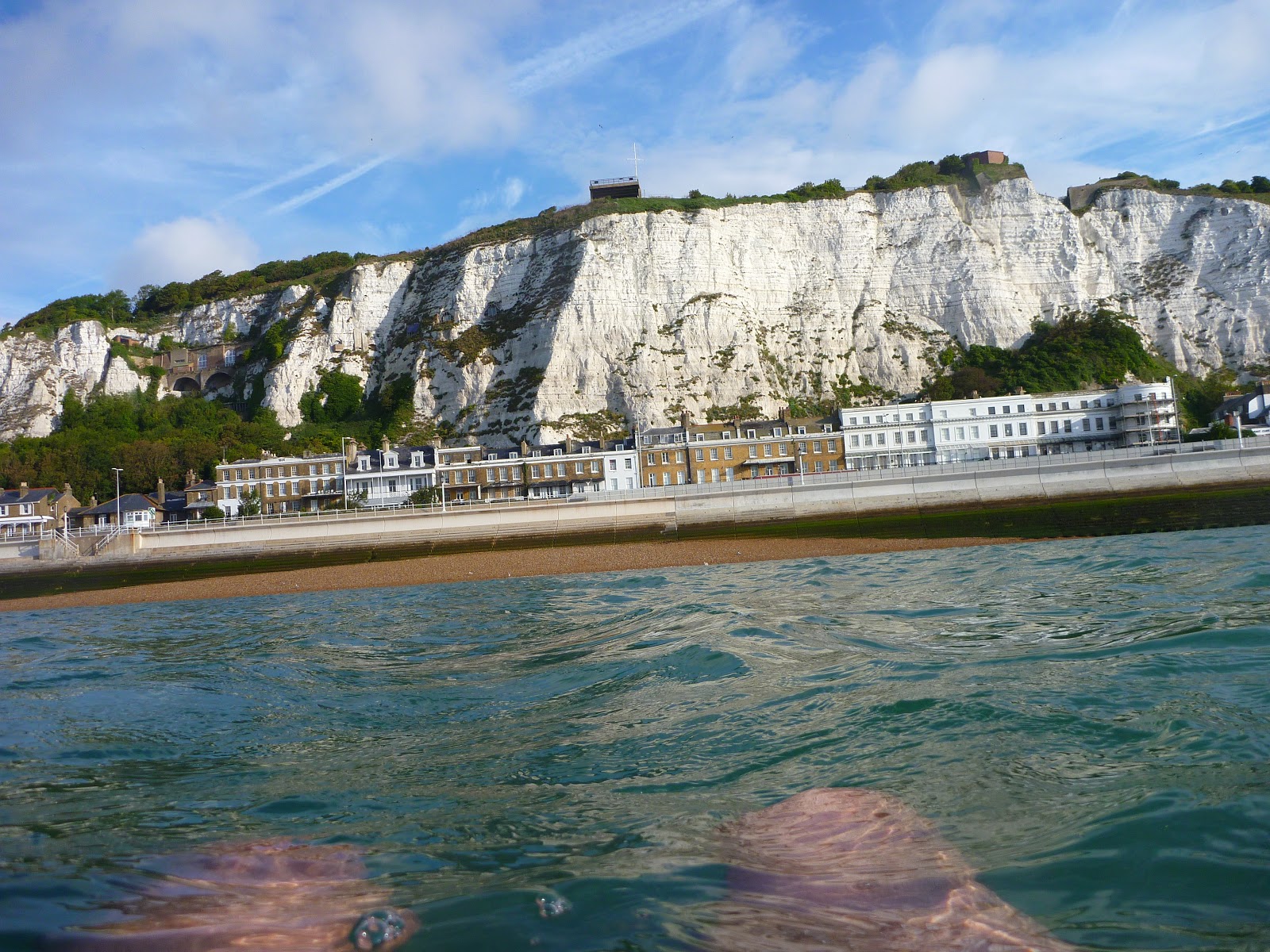
Here are some day-by-day highlights and pictures to share the experience. The day I arrived August 17th, I jumped into a sunny, warm (63f) and calm Dover Harbor which made for a wonderful swim, setting a very positive tone for what I hoped were the days ahead. Here are some of those first day pictures prior to my swim window opening.

Dover Harbor
Chalk hills above Dover

Three days later, August 20th came around and you can see below the typical day from that point forward. there were days with some breaks in the clouds, rain and wind coming intermittently but these usually came with choppy seas. Some of the nicer days that followed thus were already booked up by others waiting patiently before me, in some cases weeks. 

Some of these folks made attempts and failed unfortunately very early into their swims, thus allowing my training partner Doug McConnell to get his shot almost the day he arrived. Doug was successful in his swim ending it just as the mixed weather moved into the Channel late night near the end of his swim with 5-6 foot swells. This has been one of his life long dreams - congratulations Doug and you earned it!


EC on a nice day 3-5ft consistent waves
To the untrained eye, the sea can be deceiving especially from this vantage point above on shore (sorry for the landscape view). It may look calm but you would be quite surprised to learn these are 3 plus foot swells in-shore and further out much bigger. I learned that the biggest challenge is figuring out when to take 'your shot' is forecasting when the sea is not all mixed up and choppy. Winds pushing in the opposite direct as the tide and swells from the open ocean. I learned from our legendary Captain Mike Oram and his son that during our stay in Dover mixed weather forecasts had been the norm for this season. On-shore forecasts different from marine forecasts different from what they call MET data or meterological's.  

Just to show how weather conditions change quickly. This is a video clip was taken by someone also blown out of their swim from just outside Dover Harbor September 6th, a few days after I left England.


So seconds turned to minutes, minutes to hours, hours to days, restless nights of uneven sleep into the next day and so on. Trying to keep ones mind off what seemed to be the endless waiting was not easy and in retrospect probably (as a newbie channel swimmer) the worst part despite having been told this by our great coach Marcia Cleveland over and over. I am a pretty laided back guy but this threw me it took several days for things final began to sink in and relax. 


Even though I know I was ready, hard core trained, cold water and all, this time was like being in prison. "Nothing left but all the time in the world to think about it"...


This is the game of swimming the English channel. No pitty allowed. Many others suffered the same fate as I this season and ultimately it comes down to how much time and money you can afford to wait around for the window of opportunity. These will be good lessons for next time.


The saving grace for me was having my family there, knowing friends, teammates and folks back home were supporting me with emails of all sorts of fun and hilarious comments and best wishes like below. 


Rachel and Jennifer my steadfast safety and feeding crew always keen to protecting me through these many long swims I am sure share my disappointment and inner frustration although they never verbalized it. I know they too were anxious about what lay ahead in Dover. 
BAM jokers


Comforting me near the end of my window of opportunity was a once in a life time surprise my sister Katie Macdonald Smith (who is actually the more gifted and famous swimmer of the family) and husband Ted who organized flying her and my parents all the way from San Francisco to Dover renting a house not even 100 yards from ours. In the end, despite my personal disappointment this was a wonderful time as a family that I will cherish the rest of my life. Thanks you too!


Don & Jean Macdonald
Katie, Mom and Jennifer


Rachel


For everyone in the 220 School District, Barrington, IL, Goshen, IN (my childhood hometown), friends, teammates, family and especially the 220 Foundation I cannot thank you enough for the honor of sharing this Journey these past months. Today there are overover 6000 friends and counting, each learning sharing and I hope through my experiences, successes and failures perhaps each of us has learned to be a but more resilient. 


Some have said to me along the way - why are you doing this? Why are you sharing this Journey so publicly, exposing yourself and taking such personal risk to ones ego. My answer then and now is simply because I can. My parents and teachers took the time to teach me how to be resilient, work hard, invest myself into something. Teaching kids (and parents) that failure is simply a different direction is the first step to teaching one to be resilient. 


A resilient athlete and student understands how to train and master the body, heart and mind in the pursuit of excellence. Ego driven pursuits are always ephemeral.


No different - A resilient child/student acquires similar life skills through practice. Putting their formal training and life's aspirations to work through success and failure. Starting young, resilience is learned and quickly becomes an intuitive life-long skill when supported by strong, emotionally connected friends, family and parents whom are engaged in the many aspects of their lives.


Thanks for sharing with me all these months your warm and kind wishes. I hope we have learned something together on this Journey. there will be more 'One Stroke At A Time adventures to come so stay tuned. 


I will take my shot again some day and perhaps like 'Doc Councilmen' the famous Indiana University Swim coach, maybe I too could someday be the oldest the cross the English Channel ....but I think much sooner:)


So what's your dream? 

 "Dream big and set your goals ridiculously high and if you fail, you will have failed above everyone else's success. Successful people fail more often than succeed, but they never quit and neither should you"
Keep taking 'One Stroke At A Time' - Don