

Jul 7, 2013
Drowning Doesn’t Look Like Drowning
Accomplished swimmers, youth, older parents and even pets drown, on average, in water you can stand up in, while people look past not focused on the early warning signs.
As a former life guard, accomplished ocean and fresh water marathon swimmer, kayaker, and rafter I have saved a few souls and later reflected to my family astonished the risks people take without knowing their own capability, the power of water and lack of training or practice.
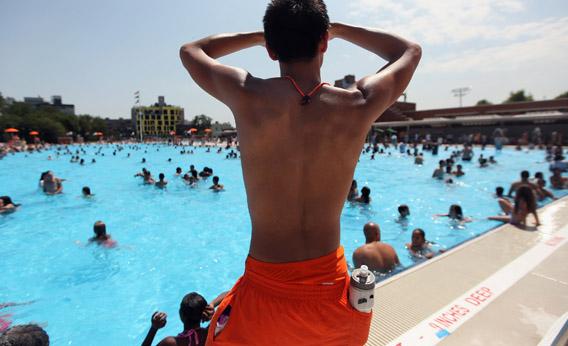
Safety in pools is well under-estimated. A lifeguard keeps watch on opening day of the newly renovated McCarren Park Pool on June 28, 2012, in Brooklyn, New York. Photo by Mario Tama/Getty Images
The new captain jumped from the deck, fully dressed, and sprinted through the water. A former lifeguard, he kept his eyes on his victim as he headed straight for the couple swimming between their anchored sport fisher and the beach. “I think he thinks you’re drowning,” the husband said to his wife. They had been splashing each other and she had screamed but now they were just standing, neck-deep on the sand bar. “We’re fine; what is he doing?” she asked, a little annoyed. “We’re fine!” the husband yelled, waving him off, but his captain kept swimming hard. ”Move!” he barked as he sprinted between the stunned owners. Directly behind them, not 10 feet away, their 9-year-old daughter was drowning. Safely above the surface in the arms of the captain, she burst into tears, “Daddy!”
 |
| Whether rafting, tubing or just floating along water is very powerful. |
The Instinctive Drowning Response—so named by Francesco A. Pia, Ph.D., is what people do to avoid actual or perceived suffocation in the water. And it does not look like most people expect. There is very little splashing, no waving, and no yelling or calls for help of any kind. To get an idea of just how quiet and undramatic from the surface drowning can be, consider this: It is the No. 2 cause of accidental death in children, ages 15 and under (just behind vehicle accidents)—of the approximately 750 children who will drown next year, about 375 of them will do so within 25 yards of a parent or other adult. In some of those drownings, the adult will actually watch the child do it, having no idea it is happening.*
Drowning does not look like drowning—Dr. Pia, in an article in the Coast Guard’s On Scene magazine, described the Instinctive Drowning Response like this:
- “Except in rare circumstances, drowning people are physiologically unable to call out for help. The respiratory system was designed for breathing. Speech is the secondary or overlaid function. Breathing must be fulfilled before speech occurs.
- Drowning people’s mouths alternately sink below and reappear above the surface of the water. The mouths of drowning people are not above the surface of the water long enough for them to exhale, inhale, and call out for help. When the drowning people’s mouths are above the surface, they exhale and inhale quickly as their mouths start to sink below the surface of the water.
- Drowning people cannot wave for help. Nature instinctively forces them to extend their arms laterally and press down on the water’s surface. Pressing down on the surface of the water permits drowning people to leverage their bodies so they can lift their mouths out of the water to breathe.
- Throughout the Instinctive Drowning Response, drowning people cannot voluntarily control their arm movements. Physiologically, drowning people who are struggling on the surface of the water cannot stop drowning and perform voluntary movements such as waving for help, moving toward a rescuer, or reaching out for a piece of rescue equipment.
- From beginning to end of the Instinctive Drowning Response people’s bodies remain upright in the water, with no evidence of a supporting kick. Unless rescued by a trained lifeguard, these drowning people can only struggle on the surface of the water from 20 to 60 seconds before submersion occurs.”
This doesn’t mean that a person that is yelling for help and thrashing isn’t in real trouble—they are experiencing aquatic distress. Not always present before the Instinctive Drowning Response, aquatic distress doesn’t last long—but unlike true drowning, these victims can still assist in their own rescue. They can grab lifelines, throw rings, etc.
Early warning signs:
- Head low in the water, mouth at water level
- Head tilted back with mouth open
- Eyes glassy and empty, unable to focus
- Eyes closed
- Hair over forehead or eyes
- Not using legs—vertical
- Hyperventilating or gasping
- Trying to swim in a particular direction but not making headway
- Trying to roll over on the back
- Appear to be climbing an invisible ladder
Reprinted Credit - By Mario Vittone
Jun 10, 2013
Junk in equals Junk out, sports drinks, carbo loading and marketing traps
Final in the series on nutritionally sound alternatives to Gu's, energy drinks and junk food for endurance athletes and open water swimmers.
As an athlete, recovery is an integral part of your program. Make it your goal to eat in the 30-minute window post-exercise, when your body is primed for nutrient uptake and carbohydrates consumed can be used to begin the recovery process.
The right kind pf Carbohydrates are essential post-exercise to replace muscle glycogen and ensure you begin your next session with maximal stores.
If fat loss is your goal, start with 30g and assess your recovery and subsequent performance. If you didn’t feel well fueled or found you did not recover as well as usual, simply increase by 10g following your next session. A little trial and error goes a long way.
Otherwise, aim to consume your body weight in grams (i.e. 1g/kg BW) of carbohydrate in your post-exercise meal. A quick example is a banana and a glass of coconut water or a fruit based smoothie.
What can I eat?
Sweet potato is the perfect post-exercise carbohydrate. Full of relatively fast-acting carbohydrates, plus vitamin A, B and C, one cup contains approximately 50 grams of carbohydrate.
Sweet potato is the perfect post-exercise carbohydrate. Full of relatively fast-acting carbohydrates, plus vitamin A, B and C, one cup contains approximately 50 grams of carbohydrate.
If bread is your thing, eat it post-exercise. I prefer to eat gluten-free, but that’s a another topic. Two pieces of bread contains on average, 20-25g of carbohydrate.
Fruit fits in nicely post-exercise too. A medium banana contains 30g of carbohydrate, so pop one in your training bag or car, so you never miss the “window”! It is important to note however, that fructose alone takes longer to resynthesize muscle and liver glycogen than does glucose or sucrose. The solution is to combine carbohydrate sources; so accelerated synthesis can take place. Eat a banana and a muesli bar, both of which are perfect portable snacks. These are ideal if you have an hour or so between races and/or travel time to take into consideration.
If you are finding it hard to quit sugar, choose starchy vegetables that do not provide the sweet craving you are trying so hard to avoid. You can even eat white potato post-exercise! Remember it’s all about nutrient timing.
What about sports drinks?The short answer is no. They are full of artificial sugar, preservatives and colours, and there are much better options:
- Coconut water: the natural sugars and electrolytes are great during, or after, an intense exercise session. One serve contains 15g of carbohydrates, so it is not to be treated like water. A couple of times a week is sufficient.
- Juice: yes, if you like, you can drink juice. It’s far cheaper than expensive sports drinks and all natural, but please save it for during exercise and in the “window” only. Ideally, make it fresh and keep it to two pieces of fruit, with the rest vegetables.
- Make your own: 750ml of water, 1 tablespoon of rice malt syrup, the juice of one lemon and a pinch of sea salt. This is perfect for on the bike or recovery from your longer sessions. Lemon is the highest electrolyte containing citrus fruit, so why not also had some to your juice.
What about carbohydrate loading?To put it simply, increasing and maximizing muscle glycogen stores takes weeks of consistent training and focused post-training nutrition. Carbohydrate loading only acts to increase your weight in race week and/or your potential for GI upset on race morning or even during the race. No thank you! It is your post-exercise recovery that is essential for optimal glycogen stores.
In summary, base your carbohydrate intake on exercise duration and personal goals. Make your post-exercise nutrition as important as the training session it follows. Fuel naturally and your performance will speak for itself. You really are what you eat.
Reprinted from:
THE NATURAL NUTRITIONIST
How to increase your performance and recovery with nutrient timing
Second in the series on natural food fueling, alternatives to Gu's, energy drinks and junk food.
Follow these three essential steps to extend your performance and optimise your recovery from both training and racing:
 1. Fuel correctly pre-exercise when your sessions are greater than 60 minutes
Training on an empty stomach is essential to turn you into a fat burning machine, but when your duration extends beyond 60 minutes, such a strategy is likely to negate your performance. Body stores alone are insufficient to supply the energy needs during longer sessions or events.
The solution? Eat a small amount of carbohydrate prior to your session. This is the perfect time to eat fruit, as the sugars will be broken down, utilised as fuel and not shuttled off to the liver for fat storage. Which, we know, is what happens when we consume fructose in excess, or at the wrong time.
* Race Day
On race day, our requirements differ slightly, due to the timing of the event and the increased energy requirements of the day. A pre-race meal is simply designed to top up liver glycogen, which has depleted overnight during your sleep. General guidelines are 200 to 400 calories of complex carbohydrates, consumed two to three hours prior to the start. Be flexible however, as sleep is more important than waking up at the crack of dawn for breakfast.
Here are some simple, natural, pre-race meal ideas, all of which can also be used pre-training when your duration extends towards 90 minutes and beyond.
- Two pieces of gluten free toast with banana
- A smoothie with one banana and a small handful of berries
- Quinoa Porridge with rice malt syrup, chopped banana and cinnamon
- Homemade granola with Greek yogurt and a small handful of raspberries
Your pre-race meal should always be something you practice in training. Nothing new happens on race day.
Reprinted from:
THE NATURAL NUTRITIONIST
Reprinted from
Nutrient Timing for Athletes – how the right types of sugar can help you
This will be the first of several posts from the same blog article. Offers great advice for those open water swimmers and athletes looking for alternate and healthful food energy sources beyond Gu's, maltodextrins and energy drinks.

First things first, a carbohydrate is a sugar is a carbohydrate. The term carbohydrate refers to organic compounds with only carbon, hydrogen and oxygen atoms and sugar, or sucrose, is just one of many. Each has their own distinct structure, hormonal response and health impact, but for the point of this discussion it is important to remember that:
- Refined sugar and excess fructose are highly inflammatory, which from an athletic point of view is the enemy to recovery and subsequent performance.
- Excess carbohydrate consumption can inhibit our body’s ability to burn fat, which is the limiting factor in endurance events.
And because I know you’re now curious, to increase your fat burning ability and therefore your endurance capacity:
- Make refined sugar free eating a priority.
- Reduce your fructose intake.
- Rely less on starchy processed carbohydrates. Fact. You definitely don’t need to be following our traditional (and now almost obsolete) food pyramid, or guidelines of up to ten times your body weight in grams per day (i.e. 10g/kg BW/day). I promise.
- Train on an empty stomach a couple of times a week. More on this to come.
Carbohydrates: friend or foe?
A day-to-day intake heavily reliant on starchy carbohydrates (e.g. breads, rice, cereals, potatoes, sugary sports drinks and lollies) will not only limit your fat burning ability, but may also result in an inadequate protein intake and a diet lacking in many essential trace nutrients, vitamins and minerals. This most certainly will have a negative effect on your recovery and performance.
To increase performance and recovery however, the right types of carbohydrates can be extremely beneficial. Here’s why:
Firstly, carbohydrates are more oxygen-efficient than fat. Put simply, more energy is produced from the same amount of oxygen when carbohydrates are broken down. Why is this important? Oxygen availability is limited and determined by your own individual maximum oxygen uptake (VO2max). The consumption of carbohydrates during exercise of extended duration therefore, tops up your individual supply and acts to extend performance. Without this, your body will simply run of fuel and eventually come to a complete stop, otherwise known as “hitting the wall”.
Secondly, carbohydrates are the only macronutrient that can also be broken down rapidly without oxygen, to provide large amounts of extra energy during intense exercise. This anaerobic metabolism is vital to maximal performance for bouts between fifteen seconds and three minutes in duration. It is for this reason that athletes such as sprinters and weight lifters should consume carbohydrates prior to exercise, in order to supply adequate fuel for the following exercise effort.
Lastly, carbohydrates act to optimise muscle and liver glycogen stores (basically the carbohydrate you eat stored in your body) and enhance recovery from longer training sessions and endurance events. So the key to carbohydrate intkae is nutrient timing – when you eat them and why.
Reprinted from:
THE NATURAL NUTRITIONIST
THE NATURAL NUTRITIONIST
May 31, 2013
'Swim Lessons' - Teaching Life through swimming
My passion, open water swimming at the English Channel level. Come join me.
Apr 3, 2013
Healthy Nutrition - What 2000 Calories Looks Like
Heart healthy nutrition for athletes (of any age) is a subject often not spoken about at the family dinner table, the team locker room, or often by coaches until you reach perhaps the elite level and even then selectively or at best incorrectly.
Coupled with ninja marketing campaigns from babyhood ranging from outright miss-information to subliminal marketing, these messages cross the airwaves and internet bombarding our kids, teens and families.
So for starters lets begin with some basics:
Subscribe to:
Posts (Atom)