Showing posts with label Don Macdonald - English Channel. Show all posts

Jun 23, 2015

USMS National Open Water Championships 15K


USMS National Open Water 15k (9.3 mile) Championships from the perspective of kayaks, support crew and chief enthusiast me and several hundred other national caliber swimmers, coaches and avid supporters.
The beginning of any open water competitive swim can be frustrating for the calm and experienced, nervous for the un prepared, and nerve racking for the newbie no matter how capable. This is my 5th or 6th one of these both as a swimmer perspective and kayaker and I can say in the end its a team effort, including those that host the event. 
Our hosts from GRIN and NASTI masters teams in Indianapolis really do a nice job, giving up their potential to swim to help others become champions. This is one of the hallmarks of our sport, giving back.

This year was no different, than those of the past, stormy and grey weather threatened but held off. a few years ago when we did the 25k, swimming this many miles in hot water makes for a long day. 

The calm waters of Morse gave way to after winds chopping up the South End as usual, so much so I ran over Doug twice trying to stay close as a guide through the maze of buoys that makes up the turn/finish area for another lap. 

As you can see in this picture the shoreline undulates back and forth requiring the swimmer to be very precise in sighting. 

Here is Doug Mcconnell and myself heading up the East River last summer while circumnavigating Manhattan Island for a good idea of how close we operate.

A really strong fast swimmer can easily fall behind lifting their head too often, burning energy from dragging their hips low in the water. Experienced swimmers realize quickly that having an experienced kayaker is really critical, using them as a sight line on one side and the tree for example on the other. It's a choreographed dance on water.

In the end we had great fun, saw many old friends, made new ones and created hope for the future of our sport and the next race or chance to swim across a big body of open water.


Jan 26, 2013

Cold-water swims - Rewards, Risks, and Your Health

Cold Water Swimming and Your Health?


Doug McConnell & Don Macdonald taking a dip in sub 60f Lake Zurich early March

What that means is that cold-water swimmers probably aren't any better protected from the elements than anyone else. Plus, at least in the Bay Area, most of them aren't elite-level athletes either. But something about them makes them better able to tolerate and
overcome the cold.

It's a commonly held belief, by swimmers and landlubbers alike, that an extra layer of fat insulates regular bay swimmers from the deep chill of the water. But Nuckton, a fairly trim swimmer himself, wasn't so sure the tourist was right.


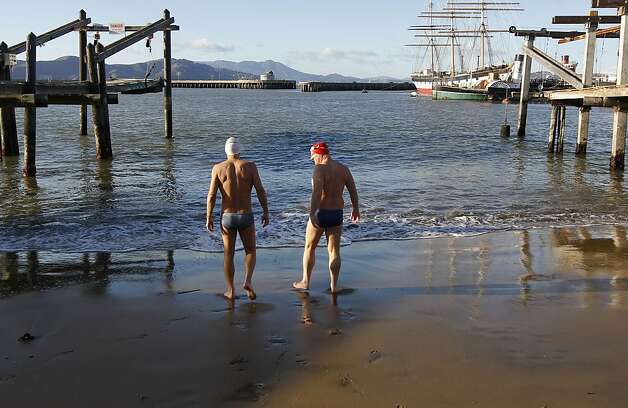
Steve Schatz (left) and Dr. Thomas Nuckton prepare for an afternoon swim off San Francisco's Aquatic Park last week. Both men are members of the Dolphin Club, which encourages swimming without wet suits. Photo: Michael Macor, The Chronicle
Last week, the Bay Area was quivering through a cold snap, and the tourists along Fisherman's Wharf were, for once, dressed for the weather, bundled in jackets and scarves, mittens and caps.
Down at Aquatic Park, Dr. Thomas Nuckton was stripped to his swimsuit and neck deep in 50-degree bay water. And he wasn't alone. Winter is the time of year that the truly devoted - or truly crazy - swimmers come out, those hardy folk who dive nearly naked into San Francisco Bay, into waters 25 or 30 degrees colder than the average swimming pool. The health benefits of these swims are debatable, the risks less so. And yet every year, dozens, maybe a hundred, people swim all through the winter months, putting in miles and hours in the water. "People will go down there to swim, and it's almost like a spiritual experience," Nuckton said. "It's not quite the same for me. I hate getting in the water," he added with a laugh. "But I have my good days. And I'd much rather be there than in a pool, staring at a black line and just going back and forth." Nuckton is a doctor at UCSF and California Pacific Medical Center, focused primarily on studying survival prognoses for patients in intensive care wards. But he's taken a side interest in swimming and, in particular, the effects of cold-water dips.

Last month, after a yearlong study of people in his swimming club, Nuckton was able to show that these swimmers are, in fact, just about the same size as the average American. Crazier, maybe. But not fatter.

"All of these factors probably come into play," Nuckton said. "How good is your engine in terms of generating heat? How cold is the water and how long are you going to spend in it?"

Schatz (left) and Nuckton brave the bay waters. Nuckton, a physician, has been studying his fellow cold-water swimmers. Photo: Michael Macor, The Chronicle
Aided by extra fat? More fit, but why? Risks overstated Peril of sudden shock

Nuckton's most recent study was prompted by a comment he overheard from a tourist standing on the Hyde Street Pier, watching the Aquatic Park swimmers. "He pointed at the swimmers and said, 'They're fatter than us. That's how they endure the cold,' " Nuckton recalled.

There is no doubt, doctors say, that regular cold-water swimmers are healthier overall than most Americans. But whether it's the cold or the simple act of regular exercise that helps them is unclear.

Over the past decade, Nuckton has made a hobby of studying the members of his swim group, the Dolphin Club. Along with the South End Rowing Club, the Dolphin Club encourages no-wet-suit swimming in the bay. The clubs' members host several group events year-round, including a New Year's Day swim from Alcatraz to Aquatic Park, and they operate hot showers and saunas for post-swim recovery.

"I'm not convinced that, physiologically speaking, cold-water swimming helps. I think these people are already healthy to begin with and they want to challenge their bodies," said Dr. Malini Singh, medical director of emergency medicine at San Francisco General Hospital. There are theories, but not much evidence, about how cold water can improve health. Some studies have shown that people who swim through the winter have higher immune cell counts than nonswimmers. And some scientists, and swimmers, have speculated that cold-water swimming increases production of what's known as brown fat, thought to be a healthy fat that burns energy and creates heat. Many cold-water swimmers believe they're burning more calories in the bay as their bodies struggle to stay warm than they would in a heated pool, but scientists aren't convinced that's the case. Cold water, in fact, slows the metabolism, which may mean that the body is actually burning fewer calories. Even if there is a larger calorie burn, it's probably negligible, doctors say.

It's not just the benefits of cold-water swimming that are tough to document. The risks are poorly understood and probably overstated too, some doctors said. Two studies of athletes competing in long-distance, open-water swims found that most of them were suffering mild hypothermia by the end of the race, even when the water temperatures were in the 60s or higher. "I know people do it. Anecdotally speaking, they say they feel refreshed, they feel less stress and less fatigue," she added. "But I've been in that water, in a wet suit, and I just felt terribly cold to my bones." Nuckton studied 11 participants in a 2000 Alcatraz swim and found that five were suffering mild hypothermia by the end of the event. And perhaps more concerning, their temperatures continued to drop after they got out of the water. But mild hypothermia on its own is not necessarily a dangerous thing. In Nuckton's study, most swimmers' temperatures dropped about 2 degrees below normal, which probably wouldn't produce any noticeable symptoms or discomfort. In order for hypothermia to cause major damage or become deadly, the body temperature needs to drop to the low 90s.

The concern with hypothermia is twofold. First, that someone may experience early symptoms of it and become sluggish or disoriented, which could be deadly when a swimmer is in deep water and has trouble making it safely back to land. And second, some older or less fit swimmers may not be as well adapted to handling the cold as their younger or more experienced peers.
"The important thing is, I wouldn't be doing this for the first time, just jumping right in, if you're elderly or have significant medical issues," said Dr. Joel Levis, assistant chief for the emergency department at Kaiser Santa Clara. "Those people are better off just swimming in a pool."

Aside from hypothermia, there is a small risk associated with the sudden shock of jumping into cold water. Anyone who has dived into frigid water knows the feeling - the heart rate soars, breathing becomes erratic, and it usually takes a minute or two to calm down. That's rarely a problem, but there have been a handful of cases of people suffering heart attacks and subsequently drowning from that initial shock.
And then there's the native aquatic life. For the most part, swimmers exist companionably with the critters, but several years ago a rogue sea lion bit dozens of people in Aquatic Park, requiring a few of them to get stitches and antibiotics.
But on the whole, a swimmer is probably more likely to be injured by someone doing a sloppy butterfly stroke at the pool than by, say, a great white shark in the open water.
"The chances of getting eaten by a shark are pretty low. You just don't think about it," said Robin Rose, an Aptos resident who swims regularly in Santa Cruz, usually doing a mile around the wharf several times a week.

Rose started open-water swimming in 2009, and she swam regularly even through treatment for breast cancer in 2010. She wears a wet suit for now - but she's seriously considering joining the "skin" swimmers sometime in the near future.
"I went to Aquatic Park, just to try it, and it actually felt really good," Rose said. "I was only in for about five minutes, and it was so cold, but it was so invigorating. There's nothing else like it."

Article Reprinted from: Erin Allday is a San Francisco Chronicle staff writer. E-mail: eallday@sfchronicle.com

Jun 25, 2011

US Masters Nationals 25k, swimming with some of the nations best Open Water swimmers

Swimming with the many of the nations best open water and in many cases that other concrete jungle with lanes, walls and lines (aka, a pool) masters swimmers is always a treat each June. I am so blessed to be able to hang with such great and selfless folks, friendly and yet when that gun goes off competitor's to the end. Vic Rian, Jim Barber, Marcia Cleveland to name a few. These folks and other's between them probably have and hold more than a few national records, perhaps some world and many age titles to their credit not to mention such huge accomplishments like the English Channel, Swim around Manhattan island (MIMS), Catalina channel, and so on. I also have the honor to swim almost daily with my training partner Doug McConnell, who in his own rite is way up the ladder in accomplishments. 

The other critical leg to any endeavour like climbing Mount Everest, is team work. This time I was treated to having my long time close friend and college roommate, Charlie Hiltunen, come along for the day and kayak alongside my long workout.

Long time friend, Charlie Hiltunen, kayaked for 61/2 hours supporting my crazy dream. I think he had it harder than me, 85f air temp and humidity. Not sure who had the harder day.
At this point in my training for the English Channel, swimming a 25k (15 miles) is akin to a long workout and this was exactly how I approached the weekend. I and Doug didn't slow down training this week to rest or "taper" as this week like so many before it was another 45,000 yards, this time the bulk coming in 'A Long Swim' as my partners blog so aptly describes. 

We arrived a bit before 6am on a warm morning, water temperature this year was a wonderful 75f (last year for the 10k Nationals it was 90f) so I was looking forward to a nice 'dip'. Storms in the area inundated us and delayed the start for two hours. So I laid down on the floor and draped my swim suit across my eyes and took a snooze. I woke up one or twice to chat with old Goshen friends Leslie Barks and Mark Ahonen which was a wonderful surprise to see after so many years and learn of their interests in the sport as well. They both are members of the host team and themselves run marathons and do tri-athlons. Anyway, They made the official call that the distance would be shorted to a 20k. However for those folks that made it to 20k within 6 hours they could continue on to the original 25k distance. 

About 30 minutes before the restart woke up a bit groggy, got changed and greased up. with a swim this long the chaffing even in fresh water is a bit unpleasant. I was feeling very relaxed and casual, an attitude I was fine with given my view of this was more training. So off we went and the day progressed. My feeding stops were similar to my attitude, a bit more casual than usual. So we chugged on, and on, and on. The sun finally came out late int he day along with some strong breeze and boat chop on lap 4. I enjoyed this since this added some distraction to the otherwise mundane left arm, right, left, right, L, R, L, R...You get the picture. Well as things went I pulled across the 20k finish line around 6 1/2 hours so my day was finished at the official distance due to the storm delay, I was a bit bummed as I was just moving long nicely in 'forever mode'. 

I ended up 5th in the nation this day in my age group and to be honest I did have a bit of that 'comptetitive remorse' for taking it so relaxed. But I'm fine with that and really more to the point, my right shoulder which had developed a pulled muscle/nerve issues at Tampa bay was clearly back where it should be. So I was comforted by knowing that going forward the next two months were full throttle.

This past week was a light week in training mileage 20k total to recovery these old bones. Today (Saturday) we were back in Lake Michigan in 57f cold water (love it!) and crystal clear water with group of 'Usual Suspects' - Doug, Marcia, Chris, Laura. 

So here we are today, just under 60 days to the the next step in the 'One Stroke at a Time' journey. I am fired up and continue to learn from all the divergent paths taken thus far, set backs, success's and other personal challenges that I have shared to date. 

I can feel the mental focus sharpening and physically stronger than I could have imagined 3 years ago. My Journey of self discovery continues to amaze me, the wonderful family, great training partners and friends that have helped me along the way is what is really important. Thanks Everyone!

Get Busy Living or Get Busy Dying! I choose to Live!


Nov 22, 2010

Qualified for English Channel, Conquering Ones Doubts

This one is for Mary Weybright! A friend who is battling for her life and demonstrating such courage and strength that by comparison makes my meager efforts herein nothing.

You go girl!

Bright eyed and bushy tailed this past Saturday I arrived at Seal Beach, CA for nothing more than a training swim or at least that is what I was telling most others. I now can admit my ego was a bit bruised when I retired from my attempt not more than a month ago stopping with cramps at 4:45 into the effort. With the encouragement of Doug, Marcia and others I delicately stepped forward in the weeks leading up to this effort working even harder in practice focusing on my mental game. I have now learned that in marathon swimming, the mental game is what separates the wheat from the chaff.  

So, here I am getting ready with Beth Barnes just before embarking on my swim. No doubt the IU swim tee-shirt was the basis for my success. The phoenix has risen, or at least for me a pigeon! What a corn ball, hey Katie! (FYI. for those of you that don't know, my sister was a stud muffin IU swimmer, twice to the Olympic trials, multiple Big Ten champ, etc, etc,) so we have fun with such things in our house! Need I say anything about Purwho, MICHu...

In usual fashion, talking about food and energy in feeds became central to the swimming effort before the jump. One of the theories I had from my first failed first attempt was that my substitution of warm tea (which seemed logical, warmth during a cold swim) was actually substituting energy out. Thus I simply ran out of glycogen and likely sodium and potassium leading to cramps. This time was to be different, no tea. So my usual mix of 100 mg (Maxim Carbo loader, 4 scoops), 1 pouch of Gatorade pro and a partial scoop of protein in 10 oz. of water would do the trick. I calculated that this provided me about 700 -900 calories per hour Yummy!.

While this rib sticking thick liquid actual tastes pretty good after 6 hour worth of feeds every 30 minutes, needless to say one gets hungry for solid food. We also mixed in one GU PAC every hour and some fresh water to rinse out the salt that was pickling my tongue. Like eating a meal after getting your teeth drilled by the dentist with Novocain.We also threw in a few Cliff bar pieces, this was so so. I really didn't want to introduce anything to new this time so rice pudding, oatmeal were left at the dock as were the bananas. Beth provided me with some maritime superstition about them, although I think it was from slipping on the peal and not eating meat. Too much grog!

I found my way to Seal Beach, CA in the capable and encouraging hands of Beth Barnes (www.Ikayak4u.com, she does a great job) via a long trail of relationships. Marica Cleveland (my coach) who had suggested I look for warmer places to re-qualify led me to Dick Sidner in Indianapolis where things were a bit warmer. Mother nature however threw me a curve ball and as most know things got cold quick here in the Midwest. Dick graciously led me to Jim Barber, Victorian Rian and Mallory Mead who themselves like Marcia are English Channel, Catalina Island and other huge swim success stories way beyond my skills. Thank you all for encouraging words and the link to Seal Beach.


The weather Saturday was 'Doverish' later said Anne Cleveland a friend of Beth's (who fits right in with those mentioned above) which I am glad she said later rather than earlier. At the start it was 54f air, grey, drizzle and a yucky wind whipped 15-20 knots coming on-shore. The salt water averaged anywhere from 59-61f for a pleasant day :) Beth made a great safety call after discussing with beach life guards the pounding surf issue and decided the swim would be around an island called Naples, which is a three mile loop just inside Alamitos Bay.

Here is a map link:
http://maps.google.com/maps?hl=en&client=safari&rls=en&q=alamitos+bay,ca&um=1&ie=UTF-8&hq=&hnear=Alamitos+Bay&gl=us&ei=I8rqTL6iLNPMngfx5YiqDQ&sa=X&oi=geocode_result&ct=title&resnum=1&ved=0CBYQ8gEwAA


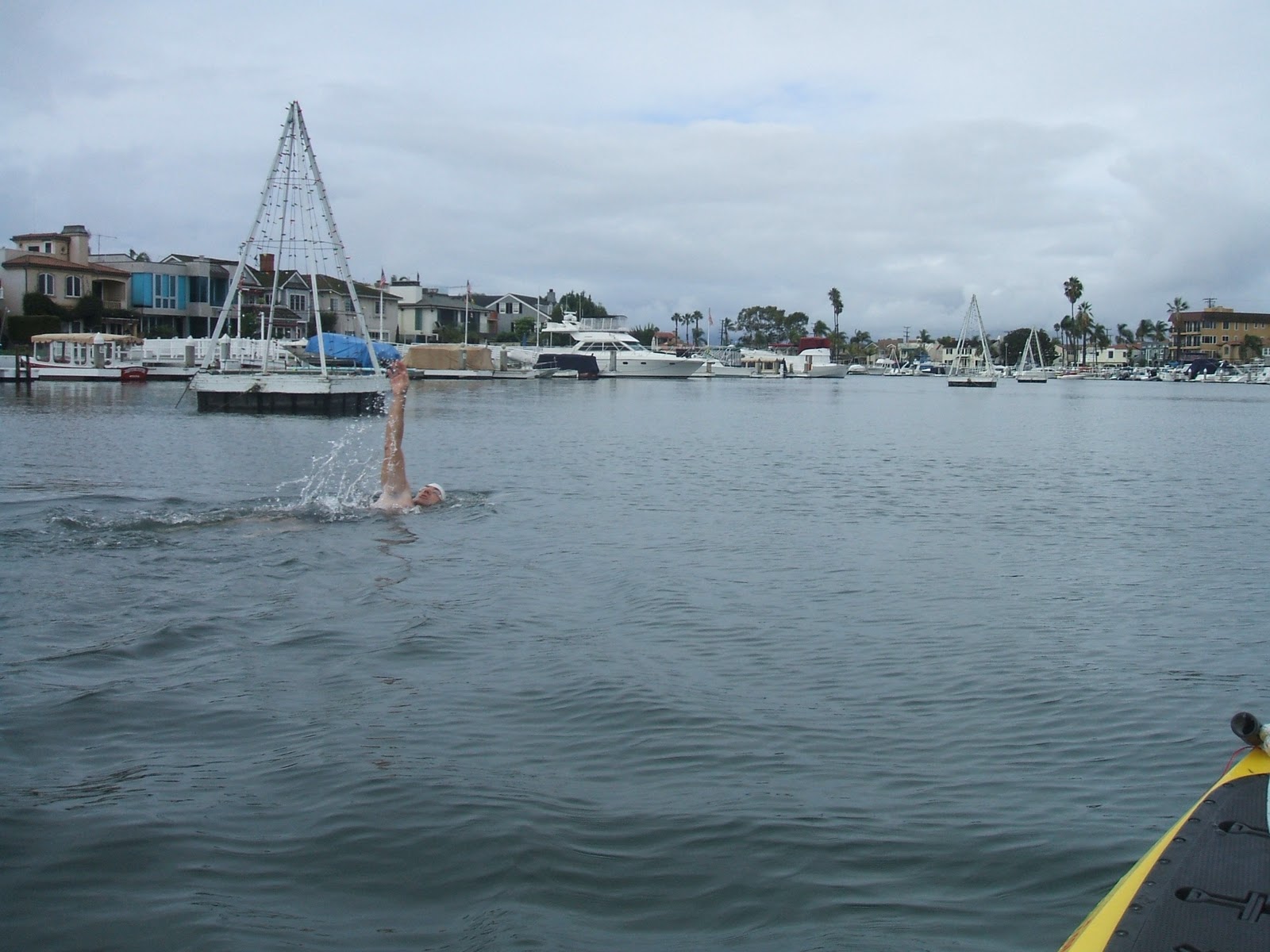
So off we went. Jumping in was the usual, a few heart pounding strokes. The water felt just fine. We were swimming by beautiful homes and huge yachts, which in retrospect I appreciate now they were at dock due to the weather otherwise I would have been dodging them all day. Below is a little backstroke warm up which as many of you that know for me is faster than my freestyle (Go figure!).

You notice the funny floating islands, well this is another tall seasonal story, yes they are for Christmas. I guess each year they float these islands with Xmas lights shaped as a tree all around the Island. They have a celebration turning them on (drinking more grog and watching 'The Grinch' - I'm embellishing a bit here). This was hilarious. Then the pelicans came in force swooping down, around us and the docks no doubt sizing me or maybe Beth up for a meal. Not sure if Beth made it without getting pooped on? But this wouldn't matter since several times during the swim the sky open up and poured rain so hard it looked like fog.


Around 41/2 hours I did feel a tightening of my triceps, as if I had little to no power but I was able to stroke comfortably but felt like like effort was much greater than before. I wonder if i was at the point of depleting my bodies carbos (glycogen) to fat. Perhaps someone that is 'in the know' can offer a better explanation. But I pushed through this time relaxed actually quite comfortably. I think the first failure taught me a lot about what this felt like and how to work through a tough patch. Good news this time I did not ever have a pang of pain like I did with the hamstring and glut cramps. 


Obviously a happy camper near the end. Those GU Pac's and Maxim mix did the trick as I worked through 5 hours, then 51/2. I was really comfortable now and easily could swim on. My daughter, Rachel will no doubt like the fact I borrowed her IU swim cap just for this occasion. 


For those of you again 'in the know' of open water swimming, I consider myself an anomaly. I have a slower stroke rate than most, averaging 47 per minute all the time, ever time. During my swim I actually took it out for a stroll at 45 per minute the first hour or so I recall Beth saying and then picked up a bit as the day went on to 47-50. Judging this against what I hope someday are my peers, they tear up the water with rates as fast as 55-70 and they do this for hours! Of course I think their nuts and just plug along (the tortoise)  plop, plop, plop... One thing for sure my stroke is very efficient, I have a long reach and long extension out the back. Marcia has been helping me train to lower my head down (like above in the picture) to relieve the C 5,6 and 7 joint pain and increase distance per stroke. I now in a pool rarely take more than 5-6 full cycles in 25 yards. Having Beth kayaking on my right side made the day a piece of cake on my neck. I did breath to the right ever so often more for relief than anything. 

So in the end, as my training partner Doug said, 'you hear-by have punched the ticket'. Must be a saying from silly sport that uses a ball or something??

While failing at my initial attempt was no fun, I do look back now and know I am much stronger, mentally tougher for it. Getting in an additional long cold training swim is worth its weight in gold having now done this twice. I look forward to endless laps in a pool (30,000 yards per week and up) for several months. I hope to steal away to somewhere warm and do a long swim this winter. Next up is perhaps some training in Tampa Bay, FL with an eye on a 24 mile race across Tampa Bay, FL in April. While the water will be relatively warm, by English Channel standards, this is no joke swim and will be another serious test. I will be ready, I am ready. Thanks to my wife Jennifer, daughter Rachel, Doug, Marcia, the Indy folks, Barrington masters and Club folks and Dave Barra for keeping me up and on track through this great experience.

I will finish as I began with a some thoughts about Mary Weybright from Indianapolis, IN a long time family friend. 

Anything I have offered above, is shallow and a meager description of a selfish endeavor compared to Mary's fight. Mary you inspire me to give back, to do better and to offer more. I think of you often during my swims. Many times you give me the strength to push on.

You see, Mary is lying in a hospital bed, now for many months, clinging to life day to day, fighting the battle of her life. Her husband Nick, the kids and family nearby. Mary is fully aware of her challenge and the multitude of health issues that confuse the very best medical experts. I cannot comprehend this strength. She is one of life's true selfless teachers, a beacon of hope for never giving up despite the most dire times! Lying in her bed starring death in the face every day, she takes time to write little notes to friends and family to see visitors and give kind looks and a warm handshakes. During this Thanksgiving season, perhaps Mary can teach us all to deal with life's little setbacks differently. To work through bad days, to graciously compromise work challenges, to shrug your shoulder at being bullied at school or to simply give back in some way to others less fortunate.

I am not very good writer. Perhaps learning from Mary's strength and adding what I simplistically describe as a 'One Stroke at Time' approach to my life's journey, Mary has taught me (us) to deal with life's challenges.

Perhaps this Thanksgiving, you might offer the same support to those around you as Mary has offered? Have a wonderful and safe Thanksgiving.

Sep 25, 2010

500 Training Miles in the Bucket, A word on safety, Qualifying Update

Logged the 508th training mile today.

Open Water Safety.  After trekking 45 minutes down to Lake Michigan hoping to get a swim in at Tower Beach we arrived Marcia and her husband were there (Mark) and we or actually I should say, I, decided it was too rough. The wind was 20 knots from the North, Northeast and the whitecaps were on every wave 3-4 feet. Usually waves aren't a big deal and we can swim just out past the breakers but today the breakers were well out several hundred yards and although the water was 61f this was not a good combination without a safety boat. We turned around and drove back to Lake Zurich and got in a 2.4 mile training lap in 64f water which was a fast one at 54 minutes so a good day. Sun was out and that always helps.

Qualifying Swim Update: We continue to plan out or 6 plus hour swim and have most of the safety crews, boats lined up. We will be confirming the date based on water temperature as as of this morning its was 64f so just waiting.

Sep 18, 2010

Qualifying for the English Channel - So how does one go about this?


"If you set your goals ridiculously high and fail, you will failed above everyone else's success"...

Catching Up on the Past Few Weeks:


Its been a couple weeks since I posted anything and until this past week the mileage has been about half of the normal but I am back in full swing now logging 25k yards per week and will soon be scaling up to 30 plus. Boston was a great swim but taking a bit of break was well deserved.

Met with my coach, Marcia Cleveland and co-heart training buddy Doug McConnell this week to layout the next years training plan. Looks like once we complete the 6 plus hour cold water qualifying swim in the next few weeks (60f or below water temp is required?) we'll be back to normal training until April when we will do the Tampa Bay marathon swim (24 miles, ocean but warm water - purpose to check distance and ocean affects on body, mind and foods to eat, etc. without the cold so training can be adjusted). Will plan to be back in cold Lake Michigan early April as much as possible and then do another 8-10 hour swim late spring/early summer. August 2011 is the Channel so everything will build to this. I can't believe I have already put over a year into this! I remember when I started I could barely finish 2000 yards without being tired, go figure. I couldn't handle cold water, waking up at 5 am, eating really funky foods, etc. I have everyone to thank for tolerating me and this dream, the crazy schedule, time away, standing in the cold watching me swim or just sending wonderful email notes. Thank you very much.


English Channel Qualifying Swim:


Echoing my thoughts on how I got to this point, I now look forward to the next several weeks with a bit of trepidation knowing that lurking out there is the biggest test yet of my mental preparations but also physical. 6 hours minimum in water 60f or colder. I have previously written about other cold training swims and races but wrapping my head around swimming for 6 plus hours AND 60f is really tough. Today I was in Lake Michigan for an hour in 54f - 56f water, grey skies and air temps. hovering around 65f. It was bone chilling, burned like I can't even describe getting in but was able to calm down and focus on swimming as the time went on. Will do this again Sunday and as much as possible in the next days leading up to the fateful phone call from the coach...tomorrow is the day...

The basic plan is to start at 4am (yes, your reading correctly 4am, pitch black darkness and cold). Swimming the EC starts 24/7 so swimming in pitch black cold wavy water is part of the gig. Well I am about to be baptised in a big, big way.

At these water temperatures, hypothermia is a very real safety concern. We take great care to monitor each other. Also strangely enough what you eat as your fuel is critical. Your body is effectively consuming food to produce energy for two things, the swimming strokes themselves and the to generate heat! So this will be a very important part of our qualifying swim planning.

We are also having to plan for kayaks and safety people to be with us the entire time. They will have the authority to stop the entire swim if they fell we are in danger. They typically test you during a feeding stop by asking simple questions. Not being able to speak clearly and answer the specific question asked is a hallmark early sign of hypothermia. We can increase food intake quickly or stroke rates to compensate this but its a slippery slope once it begins. all of this is the purpose of doing this now, to test where I am, what needs more work. there is plenty of time to make mid course corrections.

From a mental standpoint, the deprivation of staring into blue green water for what seems to be an eternity is something I am not sure how to imagine? How do train for this? I think the best I can do is to layout a plan of swimming "x" times back and forth from the peer to the beach or something that can give me a mental goal that can be attached to the physical demands on my body. I suspect the emotional aspect of this "test" will become very evident and at some point I will simply have to buckle down and say to myself this it, its now or never, if you give up now what will you do next summer in the middle of the Atlantic Ocean!

So as plans progress I will keep everyone abreast of plans. I hope to have some video and pictures of this and if I can find someone with great IT skills will maybe even try to to a live GPS plot so those of you interested can watch live or I guess while your drinking coffee.

Jul 23, 2010

Research on why we do what we do...aka...long distance swimming

Chris Arnot
guardian.co.uk, Monday 19 July 2010 20.01 BST
Article history

Karen Throsby doing some long-distance training in 2009. Photograph: Guardian
Few academics plan to immerse themselves in their subject matter quite as literally as Dr Karen Throsby, a sociologist from Warwick University. Next month, she plans to swim the Channel as part of a project sub-titled "Embodiment and identity in an extreme sporting culture".

Her research aims to explore what motivates people to engage in an extreme sports such as Channel swimming. She has funding from the Economic and Social Research Council for two and a half years, towards the end of which she hopes to write a book that will reach out beyond the purely academic market to tap into the post-Olympic debate on the motivation to take part in sport.

"Swimming is a big part of the Olympic action plan," she says. "But I want to look at the really positive things that people can get out of physical activity and move away from the current obsession with seeing it simply as a way of reducing bodyweight." In fact, as part of her preparation for ploughing across the 21 miles of chilly, turbulent tides that separate Dover from Calais, she has had to put on a stone in weight. "I simply ate more of what I normally eat and then maintained that weight," she says.

Throsby wants her research to question orthodox ideas about what counts as a sporting body in contemporary society. And the body she is using to explore those issues is her own. Her training regime has involved swimming around Jersey in 10 and a half hours, as well as ploughing up and down Coventry's Olympic-length swimming pool, just down the road from the university. Not surprisingly, perhaps, her shoulder and neck muscles have "bulked up", as she puts it, "in ways that are counter-normative for women but not for men".

Throsby, 42, has always been interested in gender issues and is fascinated by the reaction of friends whom she hasn't seen for a while when they remark about her evident upper-body strength. Does that bother her? "In some ways it does. It's not entirely comfortable to know that you're being looked at critically. On the other hand, this is part of an experiment purposefully to change one's body while remaining in control. Women usually make those changes in the context of the socially accepted ideal of what we should look like." And that is not all the result of celebrity culture and glossy mags. "Medically, we're all supposed to be slimming down. But I have a politicised view of body size and I find the link between thinness and health very troubling. The promotion of physical activity primarily as a way of losing weight is the route to shame, self-hatred and guilt."

These issues will be explored in an academic paper to be published roughly six months after her cross-Channel swim.

The success rate of the Dover-Calais swim is between 60 and 65%. Only slightly more than 1,000 people have completed the 21 miles since Captain Matthew Webb, smeared in porpoise oil, took the first epic plunge back in 1875. That is fewer people than those who have climbed Everest since it was first conquered in 1953.

Should Throsby join their ranks, it will add lustre to what she calls her "auto-ethnography". But the research project won't end there. "The second part will be a more conventional study of the community that surrounds an extreme sporting culture," she explains. "By looking at the obsessive end of sport we can learn about motivation, and that could be transferable to those who want a much more reasonable and moderate engagement with physical activity."

Aside from the Channel swimmers, there is an online community all over the world of long-distance swimmers training for stretches of water such as the Catalina Channel in California. This is comparable in length to the Channel, but not as tidal. "Our Channel still has an iconic status among marathon swimmers because of the challenges it poses," she says.

At the moment, Throsby is spending every weekend with the Kent-based community of groups who get together to train in Dover Harbour. "I shall be interviewing them at length, but it's already very clear that their motivations vary. Some are doing it for adventure, others because they enjoy a challenge. Then there are those who like to break records, raise funds for charity or simply improve their health and well-being."

Throsby will also be talking to the wider community, such as the trainers, swimmers' families and the boat pilots who offer guidance, support for swimmers in difficulty and sustenance every half hour or so: an energy drink, banana and – in her case – jelly babies. "Finally," she says, "there are the volunteers who come to the harbour every weekend to give us food, offer encouragement and look after our shoes while we're away."

The aquatic sociologist insists that swimming long distances is relaxing and "empties the mind". She knows that in her own case, however, she is going to have to fill that mind quickly. Once the swimming is over, the writing has to start in earnest.

Jul 18, 2010

2010 USMS 10K Championships Start & my race experience


Start of the Race, those that know my stroke will notice where I am, Ha, Ha!

Swimming with the Big Dogs, what an experience! U.S. Masters National Championship for the 10k marathon race was a solid success for me and a wonderful experience participating with 200 plus total marathon swimmers from 22 states some of them former world record holders, a number that have already done the English Channel and other large marathon events. 

I placed 5th in my age group (45 - 49, they break down every 5 years) and 51st overall. It took me just over 2 hours and 50 minutes to complete the 6.2 mile course (2:52.26 to be exact). This is a personal best for me and I dropped 14 minutes from my previous 10k just 3 weeks prior.

Here is the sun rising just before warm-ups! what a beautiful view:


The event was held at Morse Reservoir in Noblesville, Indiana in very warm (hot by my definition these days) of 84f. The water was so warm that dehydration and heat stroke was as reality. The water being so warm of course had algae blooming very thick (...think very diluted split pea soup, I could barely see my hands as they entered the water and pulled beneath my chest). The air temperature was also in the high 80's when the gun went off at 7:00am. So the total thermal heat load was some 160 degrees which is huge almost comparable to the Hawaii Iron man. In the end, everyone was safe but seriously dehydrated. I have probably drank the better part of 1-2 gallons of various fluids since then Saturday after the race until Sunday evening.

The race for me was my first ever national level event so the nerves were a bit rough, didn't sleep very well the night before waking up at 3am two whole hours before I was supposed to wake up. Tried to go back to sleep but found myself, dreaming about big lochness water monsters. So perhaps someone out there can tell me what that meant? Jennifer, my wife was so gracious to follow me on this trip and get up early as well braving the non-Starbucks start of the day. We arrived at the event and lots of folks were already in swim suits chomping at the bit. You could cut the excitement with a knife as folks mulled around preparing themselves with swim caps, Vaseline (we use this where needed to prevent chaffing), goggles, etc. As start time neared, folks were in doing there warm up swims of a couple hundred yards. You could already smell the safety boats engine oil and gas wafting in the air and taste in my mouth. We did the usual national anthem which was really something with the sun coming up and 200 folks standing in their swim gear. I found myself thinking about the movie "Apocalypse Now" and the part where where the Colonel says something along the lines of "I love the smell of Napalm early in the morning...Its, Its, the smell of victory"! 

The first wave started at 7am and the second wave, which I was in, at 7:05am. So about 60-80 people per wave went tearing off in a wild frenzy of arms and legs, climbing over each other, bumping, etc. I was pleased to not feel much of this as I usually like to stay away from the fray so as not to expend extra energy but also to mentally allow myself to get into a rhythm. For me it takes somewhere up to a mile or so to begin to settle down into what feels good. But in this hot water, it was very different this time, the heat load came on quick and I could tell by my breathing my body warmed up and it was going to be really important to "listen to my body" and work through the different feelings of stress, pain and aches.

The course is a two lap circuit each three miles (5k) around. The course was very comfortable for me to navigate, I prefer long open stretches rather than circling around buoys. Each way up or down is about 1.5 miles. We started at the bottom of the picture. At each end I stopped for a very quick (10-20 seconds) gulp of water and a GU pack. At the half way point, I gulped down an 8 oz. bottle of my usual Maxim energy drink. 

My first laps were pretty consistent time wise ranging anywhere from 40 odd minutes and seconds to 46 on the third lap and then negative splitting back down to 40 minutes on the last lap (this was really tough however).  I began to feel either cramping or the cumulative affects of the dehydration in my arms half way down the third lap or it could have been the slug of carbohydrates I had just consumed 20 minutes before at the half way point? (I need to learn from this as it was a challenging period). My stroke shortened and I had to really focus on staying calm and to relax during this segment but as the next several hundred yards passed so did this feeling. After hitting the last turn I knew I was doing well, I felt better and as I pulled away from the turn buoy I felt my longer relaxed stroke come back. As the yards ticked away, I got stronger, I could see people in front me and slowly worked to pass as many as I could. I was a mental rush seeing someone splashing away 100 or 200 yards up and then a few moments later passing them. The last turn buoy before the finish I was in all out sprint, it hurt like hell but I was in the zone. I drove to the finish and popped up just across the line with a cheery Hi, that was fun comment to the race officials as I backstroked over to the beach. Of course moments later the endorphins came crashing down and it was then I realized I was hot and tired. I didn't stay in the water to warm down like usual because it was so hot. Everyone was happily talking and sharing there experiences, young and old. 

Everyone finished up and we proceeded to have a lunch and awards. I was astonished to see the age groupings, there was a small group of just out of college kids then very few later 20's to early thirty year old's. The bulk of these talented swimmers really started in the late 30's, then my age grouping but the biggest group was the 50's. there were a number of 60 year old's as well. This was truly remarkable to see.

About the time we finished up with awards for the top eight in each age group, one older guy came in and finished 4 hours and something seconds. Everyone stopped what they were doing and began to cheer with thunderous applause. In that moment I discovered why I love swimming, but more to the point the people that swim with you. This is a very small fraternity of very, very talented and in some cases world class athletes that are caring and engaged with their competitors and their families. 

My training partner, Doug McConnell and Coach Marcia cleveland were there as well. Marcia won her age group and yes, she stomped my butt again swimming something like a 2:40 race. Doug had a great swim, he has been coming back from spine surgery earlier in the year and had missed three months of practice. He finished 6th in his age group 50-55 in with some real fast guys around 2:50 minutes. 

One fun note for the Goshen, Indiana folks! I Dave Oplinger (swam in the late 1970's with the Gibsons, Neff and company) was there in a relay. I hadn't seen Dave since high school and it was really allot of fun to see him again and share great memories and laughs. He did well in his relay and also swims Masters in Indy, still cranking out the butterfly.

In the end it was a great experience and very different from my larger goal of swimming across a large open water distance like the English Channel. Hey this was the US Nationals! 

Jul 2, 2010

2.5 miles of lake Michigan practice, 1 miles up and down

Cruising through the weeks leading up to masters open water national 10k(6.2 mile) race and continue logging 28k yards per week. Spent this week in the open water, except two pool practices, focused on longer swims at a solid pace and working on technique. Tired but gaining confidence to swim through the next several weeks and big races to my real test, that at Boston 8 to 10 miles cold (55-65f) ocean race then on to my 6-8 hour English channel qualifying swim in the fall.

Had a good swim with my coach (Marcia Cleveland) in lake Michigan this week. Booked 2.5 miles in a 1-3 foot swells. Learning to sense the pattern of the waves, several big rollers and the calm. During the calm I take advantage and bi- lateral breath which balances my stroke and releives my neck stress, then back at riding the waves. It's amazing how different it is swimming in even easy rolling waves, the extra time it requires, to complete the same distance in a pool or smooth lake. But I am now confident I can take on some big wavy water if needed and be patient and work through it. Next on my trainig regime is to swim a night. I finally found a few folks willing to tolerate me crazy dream and help me out at night kayaking with glow sticks and head lamps while I swim. We'll try easy lake Zurich first and then move on to lake Michigan.

As for Boston, I will be honest I am a little nervous, it's my first big ocean swim despite the fact that I will have been swimming in and around martha's vineyard the week before. Guess where jaws was filmed ... You guessed it...martha's vineyard. Oh the joy of knowing this. But I have to face these fears because In the end, get busy living or get busy dying. I'll be just fine in all these but it's the mental game.

Thank you to everyone that sends notes and akses about how it's going. You can't imagine the challenge of something this big, the details, the logistics, the learning of both oneself and how to work with mother nature. Special thanks to jennifer, mom and dad, Katie, Ted, Kevin, and my swi coaches marita, Marcia and John, and doug McConnell (he inspires me every to try harder). Oh one last driving reason, to teach my daughter that despite very big odds, something like this can be done, I hope she someday she has a similar opportunity of a life challenge.

May 29, 2010

62 degree's and Big Surf in Michigan

Had a great swim yesterday morning in lake Michigan at tower park beach in winnetka,IL water was a balmy 62f and pretty wavy. Got to swim with my coach Marcia Cleveland and one of her swim buddies. I was in good company as both are very accomplished open water swimmers. These opportunities to swim with folks like this is so important for me as I learn just how different open water swim technique from the pool.

When we first got in, I was a bit nervous as Marcia said "Oh this is about the worst you would swim in in the english channel". Needless to say I was a bit concerned bordering more on 'what the F $&@(/;... am I doing'! Getting in the cold water was not the challenge and that aspect felt just fine, every swim in cold water accumulates on you and makes the next time easier. The waves took at least 15 minutes to get used to and I swallowed lots of water. As time went on I began to sense the pattern of the waves and then started to relax.

I have three weeks until my first 10k (6.2 mile) swim in lake maxencukie (sorry I know this is spelled wrong)' anyway it's the lake at Culver military. So this should be a calm, relative long workout swim and just doing it to get a sense of the distance. In the coming weeks my trainignwill continually be at 4 - 6 miles a couple times a week with the balance being pool workouts. This should be fun.