Showing posts with label dave barra. Show all posts

Feb 21, 2017

Swimming the Distance: How Do We Get from Here to There?

Swimming the Distance: How Do We Get from Here to There?

2014 Don Macdonald's watchful safety eye looking over Doug McConnell swimming around Manhattan Island

Last summer, 11 intrepid individuals jumped into the Cal-Sag Channel as part of the Cal-Sag Plunge. This monumental occasion signified that the more than 100-year history of the river as a sewage canal is over and recreation in, on, and along the water is here to stay. 
But is the river really safe enough for swimming? Who says so?  And how do they know?
Please join Friends of the Chicago River, along with other water quality experts, policy advocates, and urban swimming champions as we explore these questions and discuss how to make swimming in the Chicago River system a reality.
Speakers include David Barra, New York Open Water; Jessica Dexter, Environmental Law & Policy Center; Willie Levenson, Human Access Project; and David St, Pierre, Metropolitan Water Reclamation District of Greater Chicago. A panel discussion will follow.
Click here for the summit agenda

Chicago River Summitt


Sep 16, 2015

The Lure of the Monster - Dying for what You Believe In

I am haunted by my English Channel experience


There is not a day goes by that I do not think about returning, seeing if I could cheat death, even by just little bit. After spending most of my life swimming, years training she is a cruel mistress and maybe, just maybe, may take me yet. 


One recent such account is Gino Deflorian, as recounted by EC legend Kevin Murphy, 34 time EC swimmer who similarly has almost died himself. Here is the story.

Gino Deflorian has already been swimming across the English Channel for eight hours. The sun is shining, the air is clear and the water is calm and flat, but the conditions are deceptive.

He is swimming freestyle as reliably as clockwork, consistently taking 54 strokes per minute. When he lifts his head to breathe, he can vaguely make out his destination on the horizon, Cap Gris Nez, a promontory on the French coast.

Deflorian is wearing a latex swimming cap, an ordinary swimsuit and goggles. His shoulders and armpits, neck and crotch are coated with lanolin, to keep his muscles flexible and prevent chafing. According to the rules, neoprene is not allowed. If he succeeds Deflorian, 24, will be the first Swiss swimmer to swim across the Channel.

The Rowena, a blue fishing boat accompanying him on his route, is chugging along next to him at 1.6 knots. Deflorian isn't allowed to touch the boat or a person. If he does he'll be disqualified and will have to get out of the water. An inspector on board pays close attention and keeps track of times, coordinates and Deflorian's stroke rate.

The captain's son is urinating over the railing at the boat's stern, and Gerard Moerland, Deflorian's coach, is sitting on a green camping chair on the port side, observing his swimmer. He ignores the ferries, the container ships and gigantic oil tankers as he focuses on Deflorian, making sure that he doesn't start slapping the water instead of gliding through it. If that happened, it would be a sign that something is wrong.
"Am I worried? Of course. Constantly," says Moerland. He looks at his stopwatch, and then he shouts: "Captain! Food!"

Pale Lips
It's time for a boost of energy, which happens every 40 minutes. As the boat slows down, Moerland tosses Deflorian a bottle and a bag attached to a rope. The bottle is filled with Coca-Cola and the bag contains a roll with Nutella. Deflorian turns over onto his back and allows his body to drift. He can hardly get the bag open, because his fingers, wrinkled and white down to the middle joints, are shaking so badly. His lips are pale.

The English Channel is brutally cold, although on this Tuesday in late August the water temperature is 16.8 degrees Celsius (62 degrees Fahrenheit). Water conducts heat 25 times as efficiently as air. The Channel is literally sucking the life out of the swimmer.

"Gino, how do you feel?" Moerland asks.
No response.
"Gino?" 
"It's getting cold," he replies. "And my triceps hurt."
"Okay. That's what we trained for. Just keep swimming."

Deflorian forces down the last bite and starts swimming again. He's swum 25,326 strokes since 9:25 in the morning, when he began his journey on a pebble beach at the Samphire Hoe park, directly at the Eurotunnel.

Deflorian keeps swimming. Now he's up to 25,410 strokes. Standing at the helm of the Rowena is the captain, known as the pilot, who is guiding him across the Channel. "He's gradually beginning to suffer," he says. "The demons of the Channel are trying to get to him." Deflorian keeps swimming. 25,912 strokes. 

The English Channel is to long-distance swimmers what Mount Everest is to mountain climbers: the biggest legend their sport has to offer. The strait between England and France measures 33 kilometers (21 miles) at its narrowest point. It's also one of the world's busiest shipping lanes, with about 500 ships passing through it every day. Swimming across the Channel is an extreme experience, a test of will and a personal challenge.

A Purgatory
It isn't an exclusive adventure by any means. By the end of 2012, 1,341 swimmers had conquered the Channel, and more swimmers attempt the crossing each year. There are about 300 in this year's season, which lasts from June to September, but only one in five swimmers makes it. There are eight deaths on record. 

"The only thing that counts is getting there. That's the lesson the English Channel teaches you. It's a purgatory. If it were easy to make it across, it wouldn't do anything for you. When you've made it, you're a different person afterwards," says Kevin Murphy, the so-called King of the Channel, who has swum the Channel 34 times, more than any other man in history. 

Murphy, born in 1949, was a fat child who wasn't good at soccer, so he began swimming instead. A row of certificates documenting his achievements hangs in the hallway of his apartment in Dover. He has swum across Loch Lomond, the largest lake in Scotland, and he has crossed the channel between Ireland and Scotland. "But you only get to be a real hero when you've tackled the Channel. It beats everything else," says Murphy.
He has had to be rescued from the water when he lost consciousness, he has had surgery on both shoulders and he suffered a heart attack. Murphy is a wreck. He hasn't swum in seven years. "Mentally, I can't handle the loneliness in the water anymore," he says. The Channel got to him in the end. 

Those hoping to swim across the Channel must register with one of two organizations. Murphy is the honorary secretary of one of them, the Channel Swimming & Piloting Federation. To receive permission from Murphy to embark on the swim, swimmers must provide proof of having swum for six hours nonstop in water at a temperature of no more than 16 degrees Celsius. The rule was established five years ago. "We're thinking of increasing it to eight hours," says Murphy. "Because of Susan."

'Possibly a Heart Attack'
He's referring to Susan Taylor, a British woman who died in mid-July, less than two kilometers from the French mainland and after 16 hours in the Channel. Murphy was her mentor when she was at a training camp on the Mediterranean island of Mallorca in April.
"I never would have thought that she would have problems." Taylor had to vomit because she was exhausted and had swallowed too much salt water, Taylor's brother, who was on the support boat, told Murphy. She wasn't far away from the French coast and didn't want to give up. She stopped swimming freestyle and switched to breaststroke, but after 10 or 12 strokes she said that she could no longer feel her legs. "She only took two more strokes after that," says Murphy. "I suspect it was hypothermia or dehydration, possibly a heart attack."

It's been nine hours and 20 minutes, and Deflorian is still swimming, 29,538 strokes so far. It's time to eat again. Eating is the only respite for the swimmer, whose body becomes a crisis zone. The cold is like a small rodent eating its way inside. There have been swimmers whose core body temperature was a life-threatening 31 degrees Celsius when they reached their destination.

This time the crew tosses Deflorian a honey-flavored energy bar and a sports drink, which consists of 90 percent carbohydrates. He burns about 800 kilocalories an hour, the equivalent of one-and-a-half bars of milk chocolate or eight-and-a-half slices of whole grain bread. "You can't eat enough to compensate," says trainer Moerland. "You need reserves."
Body fat is a swimmer's lifesaver in the English Channel, because it insulates the body, provides buoyancy and supplies energy. For weeks, most swimmers fatten up with an agonizing diet consisting of large quantities of bacon, pasta and nuts. Women are more successful at crossing the Channel, because they typically have more body fat than men.
Deflorian is 1.85 meters (6'1") tall and weighs 92 kilograms (203 lbs.). He has only 14 percent body fat. He isn't obese, just stocky and barrel-chested. "He's shaped like a whale," says Moerland, "but he could certainly use a little more fat around his ribs. The movement should keep him warm."

Painful Stings
"Everything okay, Gino?" Moerland asks. "Can you pee?"
"Yes, but it's hard to get it out."

When the undercooled lower abdomen becomes too cramped, the swimmer has trouble urinating. Swimmers are often forced to give up because their bladders feel like they're bursting and they can no longer endure the pain. Some become seasick while swimming in waves up to one-and-a-half meters high, while others contend with painful stings from the lion's mane jellyfish.

Moerland came prepared. He has brought along acetaminophen for pain, an antihistamine, caffeine to combat fatigue and cinnarizine for dizziness and nausea.
"Come on Gino, let's go!" Moerland shouts. Deflorian keeps swimming. 29,545 strokes.
In the one minute it took him to eat, he has drifted 120 to 150 meters away from the boat. The tidal current in the English Channel can range up to six knots and can flush away a swimmer like an empty bottle.

That's the reason why no one is able to make it France in a straight line, instead following a curved route. First the high tide pushes the swimmer in a northeasterly direction, and then the ebb tide pushes him back to the southwest. Swimmers who make it across the Channel have in fact swum at least 44 kilometers.
Deflorian is swimming near the bow of the Rowena, where the pilot can see him. For the swimmer, the pilot acts as a guide dog of sorts. He decides when the swim will take place and which course to follow. 

Deflorian's pilot has been working as a fisherman for 40 years. He catches crabs, mussels and snails, but working with Channel swimmers is much more lucrative. He charges £2,300, or about €2,735, per crossing. In weeks when the currents are especially favorable, there are routinely three swimmers a day or more attempting to cross the Channel. The fisherman could never make that much money catching mussels.

Too Risky
There are 13 officially approved pilots. Some are booked four years in advance.
Deflorian has now been in the water for 10 hours and 25 minutes, still swimming at 54 strokes a minute. The sun is setting behind him, and in front of him there is a full moon above Cap Gris Nez. Seven other swimmers are in the water today. Because of restrictions imposed by the French coast guard, no more than 12 support boats are allowed to cross the Channel each day. Because the French coast guard believes that swimming across the Channel is too risky, it barred swimmers from starting the crossing on its coast 20 years ago, but it still tolerates swimmers coming from England.

Moerland is standing at the railing, waving his arms and shouting: "Come on, Gino, come on!" The pilot, glancing at the radar screen and the map on his monitor, says: "If all goes well, he'll be there in less than an hour. But if it doesn't and he hits a wall, the current will push him past the cape."

But Deflorian doesn't hit a wall, lifting one arm after the other, meter by meter. 32,940 strokes. He's as stoical in the water as he is on land.

A year ago, Moerland asked Deflorian if he was interested in swimming across the Channel. The two men know each other from their club in Uster, a town near Zürich. Moerland is from the Netherlands, a country with a long tradition of long-distance swimming. He has coached swimmers in four Olympic Games. Deflorian has been a competitive swimmer since his youth, and he's talented, "but he would never make it to the World Championships or the Olympics," says Moerland. "The English Channel is just the right thing for him."

'I'm Hungry'
"It's not about anything for me," says Deflorian. "I just want to swim from England to France."

They arrived two weeks before the planned date of the crossing. Deflorian practiced in the Dover harbor basin every day, along with a group of other swimmers: two female students from Chicago, a heart surgeon from Cape Town and a 70-year-old Japanese man from Hiroshima.

Then it became windy, with gusts of up to 6 on the Beaufort scale, and Deflorian had to wait. Besides, the Japanese man was still ahead of him. Two camera teams, one on board the Rowena and one in a helicopter, filmed his progress. He gave up after 12 hours, five kilometers from his destination, because the strong current prevented him from reaching land.

The Rowena stops 1,160 meters (3,805 feet) off Cap Gris Nez, because the water is getting too shallow. A rowboat accompanies Deflorian for the last kilometer, because he still isn't quite there. Some swimmers were so exhausted that they couldn't complete this last, short stretch of water.

It's getting dark, and Deflorian keeps swimming. "Yippie!" Moerland bellows, jumping up and down on the deck. Then Deflorian drags himself out of the water and onto the beach. When he pulls off his goggles, his eyes are set deep in their sockets. Finally, he stands on the beach and raises his fists to the sky. His mouth forms a thin line, as if paralyzed, but then he manages a smile. He's made it. After 11 hours and 6 minutes in the English Channel. And after swimming 35,100 strokes of freestyle.

Reprinted from der Spiegel

Jun 23, 2015

USMS National Open Water Championships 15K


USMS National Open Water 15k (9.3 mile) Championships from the perspective of kayaks, support crew and chief enthusiast me and several hundred other national caliber swimmers, coaches and avid supporters.
The beginning of any open water competitive swim can be frustrating for the calm and experienced, nervous for the un prepared, and nerve racking for the newbie no matter how capable. This is my 5th or 6th one of these both as a swimmer perspective and kayaker and I can say in the end its a team effort, including those that host the event. 
Our hosts from GRIN and NASTI masters teams in Indianapolis really do a nice job, giving up their potential to swim to help others become champions. This is one of the hallmarks of our sport, giving back.

This year was no different, than those of the past, stormy and grey weather threatened but held off. a few years ago when we did the 25k, swimming this many miles in hot water makes for a long day. 

The calm waters of Morse gave way to after winds chopping up the South End as usual, so much so I ran over Doug twice trying to stay close as a guide through the maze of buoys that makes up the turn/finish area for another lap. 

As you can see in this picture the shoreline undulates back and forth requiring the swimmer to be very precise in sighting. 

Here is Doug Mcconnell and myself heading up the East River last summer while circumnavigating Manhattan Island for a good idea of how close we operate.

A really strong fast swimmer can easily fall behind lifting their head too often, burning energy from dragging their hips low in the water. Experienced swimmers realize quickly that having an experienced kayaker is really critical, using them as a sight line on one side and the tree for example on the other. It's a choreographed dance on water.

In the end we had great fun, saw many old friends, made new ones and created hope for the future of our sport and the next race or chance to swim across a big body of open water.


Feb 12, 2015

A Navy SEAL Explains 8 Secrets to Grit and Resilience

Getting Across

Outtakes from Article by Erin Barker


In this series we are breaking apart Erin Baker's article on why Navy Seals are so tough (Resilient) and what the everyday open water marathon swimmer can learn. 

Purpose And Meaning

To say SEAL training is hard is a massive understatement. 

The initial vetting phase (“BUD/S”) is specifically designed to weed people out who aren’t serious.
How do you get serious? Grit often comes from a place of deep purpose and personal meaning. Here’s James:

"At BUD/S you have to know what you’re getting yourself into and what you’re there to do.I still mentor a lot of guys who are interested in trying out for BUD/S and they always ask, “What do I need to do to make my push ups better?” or “Can you teach me the proper swim technique?” My first question is always, “Why do you want to be a SEAL? What is it about being a SEAL that appeals to you?”
The research backs James up. Without a good reason to keep pushing, we’ll quit. Studies of “central governor theory” show our brains always give in long before our body does.
“…Overall, it seems that exercise performance is ultimately limited by perception of effort rather than cardiorespiratory and musculoenergetic factors.”
But this isn’t just true for athletics, it also holds for careers. In a study of West Point alums, those that had intrinsic goals (“I want to serve my country. I want to test my abilities.”) outperformed those that had extrinsic goals (“I want to rise in the ranks and become an officer because that’s a really powerful position and it’s prestigious.”)


So purpose matters. But what’s the attitude that keeps you going in the moment? It’s actually a bit less serious.

If your just trying it to see if you will get across, you will more than likely fail.

May 30, 2014

Barrington man takes on ‘Triple Crown’ challenge with swim around Manhattan

Don Macdonald Kayak's alongside Doug McConnell here pictured in the middle of the pacific ocean between Catalina Island and mainland California in 2013.

With Doug's swim, the third leg of the Triple Crown bearing down in several weeks, we have been focused on extending training time in open water. While Doug has the Yeoman's work in the water this time, Im in the kayak again, and support crew in the boat. Both exposed to the weather (what ever condition it is) for 9-10 hours. 

The biggest concern we have for Doug is safety. The rivers around New York Harbor are very congested and dangerous with large ocean going ships, ferries - docking, embarking at all hours. These ships also generate sizable waves that multiply both in height and length bouncing off sea walls causing both kayaker and swimmer tremendous stress to stay on course. 

The other challenge are the piers. These are not your standard piers but large loading docks, commercial businesses extending into the river sometimes 100 plus yards disrupting the flow of water, swirling ebbs, causing the kayaker and swimmer direction problems and immediate danger from a collision. 

"There's no room for error, the current never stops and at 2-4 MPH, you will get dragged into a pier pole, debris, or ship very easily", said Don Macdonald who recently went on a test run while in New York. 

As a marathon swimmer myself, I know its essential for me to remain focused on all aspects of Doug's safety but not outwardly show the slightest change in my tempo, direction and even mood as things happen. And they always do. 

As these swims progress, its not uncommon for swimmers to become depressed from the solitude of the effort coupled with the physical exhaustion. As the reach 6-8 hours mark, the swimmer hits "the wall" both physically and mentally. The slightest perception of stress can be detected from the swimmer, stress from changes to direction, hitting some debris floating in the water, swallowing some polluted water ... can weigh heavily on the swimmers mental outlook. 

For both of us, this will be another test of resilience, forged in the desire of pushing oneself to help others. 
Sometimes your simply alone


Article Reprinted from Sun Times
As harsh, cold and seemingly unending as the winter was, few were clamoring to take long dips in area lakes as of mid-May.
Doug McConnell, however, already was swimming about 20 miles a week, often in lakes registering thermometer readings in the 50s and 60s, including Lake Michigan.
No, he wasn’t wearing a wetsuit. And no, he’s not crazy. He’s on a mission.
On June 28, the 56-year-old will attempt what is known in marathon swimming circles as the MIMS, the Manhattan Island Marathon Swim. Swimming long distances in breathtakingly, bone-achingly cold lakes is all part of the training.
McConnell, of Barrington, already swam across the English and Catalina channels. Only the MIMS — a 28.5-mile swim around Manhattan through the Hudson and Harlem rivers — stands between McConnell and the Triple Crown of open water swimming. If he makes it, he’ll join just more than a dozen others who have completed all three while over the age of 50.
Perhaps equally as remarkable, through a fundraising organization he started with his swimming friend and fellow Barrington resident Don Macdonald, McConnell has turned pulling and kicking his way through waves into more than $225,000 for the Les Turner ALS Foundation.
Amyotrophic lateral sclerosis, also known as Lou Gehrig’s disease, claimed the life of McConnell’s father, David, in 2006. Another of his relatives now battles ALS.
“It’s just dreadful,” McConnell said of the disease, which affects nerve cells in the brain and spinal cord. “It’s a slow motion shipwreck. To watch anybody you love go through that, to see them just go to pieces like that, it’s hard to watch.”
Proceeds from McConnell’s organization, A Long Swim, go to the Les Turner ALS Laboratory to advance treatments and find a cure. Researchers are making great strides, McConnell said.
“It’s a pretty gratifying and exciting time to be supporting research into a disease that has frustrated so many for such a long time,” he said. “There are drug trials going on. There are new discoveries about upper motor neurons.”
Dr. P. Hande Ozdinler is director of the Les Turner ALS Laboratory and an assistant professor in the Department of Neurology at the Feinberg School of Medicine at Northwestern University.
Support received through McConnell and A Long Swim has been vital, Ozdinler said. With it, Ozdinler developed a method of making corticospinal motor neurons fluorescent. The labeling makes it easier for doctors to discover what goes wrong in patients with ALS and other motor neuron-affecting diseases.
Because of the headway that’s been made, the National Institutes of Health has granted $3 million to further studies at the lab, Ozdinler said.
“Before we got the NIH money, the only support was from the Les Turner Foundation, which depends heavily on people like Doug,” Ozdinler said. “His efforts make a difference.”
McConnell, meanwhile, is focused on ensuring that his body is well-prepared for the MIMS. Though he swims throughout the year at Foglia YMCA, recent conditioning has meant 6 a.m. loops around Lake Zurich and adventures in Lake Michigan, as well.
“It’s just such a lift to be outside in the sunshine,” he said. “The water’s been cold, but boy oh boy, to be out there and watch the sun come up, it’s just fabulous.”
McConnell expects to encounter chilly waters in New York, which “had the same crazy winter we did,” he said.
“The only way to get acclimated to cold water is to spend a lot of time in cold water,” McConnell continued. “It can be unpleasant and so forth, but the acclimation really works.”
McConnell noted that hypothermia is not a condition to be taken lightly. His swims are monitored. The crew often includes his wife, Susan, and their four children, ranging in age from 16 to 26. Macdonald also typically is there, riding alongside in a kayak.
The Manhattan Island Marathon Swim will start at Battery Park, with a view of the Statue of Liberty in the harbor. Twenty-three swimmers are signed up to participate on June 28, McConnell said. Others are swimming June 14 and July 12.
Start time is 7:20 a.m. Central time.
“They time it carefully around an incoming tide,” McConnell said. “It’s what pushes you north up the East River. You swim on the East River to about 120th or 130th Street, and then you cut left. You take the Harlem River northwest and swim that to 210th Street.
“That’s where the Harlem dumps into the Hudson, and you take that back to Battery Park,” he said. “This is 28.5 miles. However, because of the tidal push on the East River and the downstream ride on the Hudson, most people do it in eight or nine hours. It swims more like 17 or 18 miles rather than 28.
“That, of course, is all dependent upon the day and how well you’re able to hook into the currents.”
McConnell said he looks forward to the event, which also is a race. He crossed the English Channel — a feat that included 25-knot winds and 5-foot waves as well as pitch-black darkness — in 14 hours and 18 minutes. The Catalina Channel took 12 hours, 41 minutes.
McConnell said that turning a personal goal into a charitable endeavor adds to his motivation.
The response from both corporations and individuals has been tremendous. Minneapolis-based Medtronic is among his sponsors. The company makes medical devices, including the PRESTIGE disc, one of which was implanted in McConnell’s spine in 2009.
“From individuals, we had some $5 donations and one that was $5,000. The message and the disease really resonate with people,” McConnell said. “Many of the donations were from good friends of my father’s. I have another family member battling with ALS now, and a lot of old friends of hers are donating.”
Anyone interested in learning more or donating is encouraged to visit alongswim.com.
“The funding that [McConnell] received has turned into something really big and really good,” Northwestern’s Ozdinler said. “Without him and the support of the foundation, I don’t think we would have been able to generate the tools we have today.”

Aug 8, 2013

Open Water Swimming - Once bitten, twice shy: our exaggerated fear of shark attacks

Something humor to think about as you wade into the calm, lovely morning swim . . .


Ok, Now that your adrenaline is pumping, here are the facts...

With open water swimming and beach season in full swing, the question inevitably arises: what are the chances of getting attacked by a shark? In a phrase: extraordinarily low – though not nonexistent. It is higher in certain parts of the US (Florida tops the list) than in others, and in some places (off Cape Cod) legendary great whites are making a comeback that can be frightening to beach goers. But is it really worth worrying about a shark strike or considering forgoing an ocean swim as an act of self-preservation?
Let's consider the numbers, courtesy of the International Shark Attack File at the Florida Museum of Natural History. Last year, 80 unprovoked shark strikes took place worldwide: seven resulted in deaths, including one in California. Fifty-three strikes took place in US waters, nearly half of them off Florida.
According to the file's analysis of data from 2000, beach goers faced a one in 2m chance of dying from drowning and other causes based on visits to east and west coast beaches. By contrast, they faced a one in 11.5m chance of being attacked by a shark, and less than a one in 264m chance of dying from a shark bite, since just one person died that year in US waters from an attack.
Put another way, more Americans were killed by collapsing sinkholes (16) than sharks (11) between 1990 and 2006, and more by tornadoes (125) than sharks (6) in Florida between 1985 and 2010. (And for all youSharknado fans, those were shark-free tornadoes.)
"Tides and currents kill more people [at the beach] than sharks that kill people," said Gregory Skomal, a shark biologist with the Massachusetts Division of Marine Fisheries.
But in some parts of the US, the number of shark spotting's has risen in recent years. Last year, there were more than 20 confirmed shark sightings at Cape Cod beaches, in areas including its outer beaches and off the mainland, and a 50-year-old man was bitten by a shark that scientists believe was a great white. (The swimmer, a Colorado native, was scarred but survived with limbs intact.)
This summer, eight great whites already have been spotted off various Cape Cod beaches, though some of the sightings may involve the same shark. The National Park Service just issued precautionary guidelines for Cape Cod swimmers.
Skomal has been tracking great whites off Cape Cod for years: he and his colleagues tagged five in 2009 and 17 in 2012. The probable reason for the increase is a resurgence in the seal population, which has been recovering over the past four decades since enactment of the Marine Mammal Protection Act, which outlawed a kind of hunting that caused the seals' precipitous decline. The National Oceanic and Atmospheric Administration estimates that the seal population in the western north Atlantic has increased by tens of thousands over the past few decades.
"I fully anticipate that the white sharks will continue to take advantage of this resource," Skomal said, noting that half of the sharks tagged in 2011 came back to the areas where they were tagged the following year. (Researchers use a few different tags, including acoustic ones that rely on radio transmitters and satellite tags.)"Everything is clicking for [the sharks] and the cafe is open for them. They will continue to take advantage of that."
A spate of shark strikes in 2001 that claimed the lives of swimmers – including two in the mid-Atlantic, 10-year-old David Peltier off Virginia Beach and 28-year-old Sergei Zaloukaev off Cape Hatteras, North Carolina – earned the season the nickname "Summer of the Shark". Zaloukaev was the last person to die from a shark bite in the mid-Atlantic. (His girlfriend was bitten also but survived.)
Still, there have been nonlethal events. Last month, 63-year-old surf instructor Barbara Corey was bitten off Holden Beach in Brunswick County, North Carolina, the first mid-Atlantic shark strike this year. Last year there were two, both in North Carolina, where six-year-old Brooklyn Daniel was struck off Brunswick and 33-year-old Megan Konkler was bitten off Nags Head Beach.
Florida's Brevard and Volusia counties, including tourist hot spots such as New Smyrna Beach, routinely lead the US in the annual number of shark strikes because they have a a huge number of surfers and swimmers and are in the migration routes of black tip and sandbarsharks. Together they made up 15 of the 53 recorded US attacks last year, though most of these tend to be minor scrapes since the species there are less dangerous than those found in other areas.
Commonsense precautions – avoiding areas where seals congregate, staying close to shore and staying out of the water around dawn and dusk, when sharks tend to be feeding and water visibility is low – are the best ways to avoid coming into a contact with a shark, experts say.
The shark species that pose the greatest risks to humans are great whitetigerbull and oceanic whitetip sharks. So the regions of the world where some of these sharks swim – including Australia, South Africa and California, where great whites regularly migrate – tend to have more fatalities. Of the seven fatalities last year, according to the International Shark Attack File, three were off South Africa, two off Australia, one off California and one off the French island of Réunion in the Indian Ocean.
Despite its small size, Réunion has emerged as one of the world's deadliest shark sites: a 15-year-old was killed last month off a beach where swimming was prohibited, the second Réunion death this year and the fifth since 2011. Scientists do not know why this number is so high, but George Burgess, director of the International Shark Attack File, said he suspects that human factors are playing a role. Island residents have cut back on shark fishing because of concerns over the toxins in shark meat; Burgess said an increase in global tourism means more people who are not familiar with the island are visiting and swimming there. "Now you've got a great rush of people in the water who don't know the area, and don't know the risks," he said.
Christopher Neff, a doctoral candidate at the University of Sydney who researches the human-shark relationship, said that humans are becoming more open to protecting sharks in the open ocean even as they're growing more hostile to those near shore. In March, theConvention on International Trade in Endangered Species of Wild Flora and Fauna (CITES) agreed to impose new rules on the trade inhammerhead, oceanic white tip and porbeagle sharks under which countries would have to prove their catch was sustainable before exporting it.
In December, French Polynesia and the Cook Islands joined together to create the world's largest shark sanctuary, emulating small island nations such as Palau and the Maldives in banning all shark fishing in their waters.
But both western Australia and Réunion have authorised shark hunts in the wake of deadly strikes there. Neff noted that researchers have become better at tracking sharks' swimming patterns with the use of satellite and radio tagging, but sharing this sort of information "can arouse public anxiety", and it can't prevent some of the inevitable human-shark interactions that arise.
"Anywhere we have a beach, we likely have sharks," he said. "The difference is that until now, we didn't know it."
This article appeared in Guardian Weekly, which incorporates material from the Washington Post

Feb 12, 2013

Cold Water Swimming Affects

Cold water immersion diuresis (urination) is common to cold water swimmers and is the strong desire to pee after (and sometimes during) swimming in cold water.

Marathon swimming requires one to overcome this 'societal faux pas' as a matter of time in the water but as the article points out, it is critical in replenishing liquids (hydration) and nutrients for fuel.


As we have now discussed many times, swimming in cold water leads to peripheral vasoconstriction, by the cold of the water leaching away the heat of the blood vessels closer to the surface. The blood vessels constrict resulting in reduction of blood flow in the body’s extremities to conserve heat in the cold.

This reduction in blood flow to the periphery therefore actually leads to a quick increase in blood pressure. The body attempts to compensate for this increase in arterial blood pressure by relieving itself of liquid elsewhere. The easiest, quickest and least costly expenditure from a metabolic (energetic) point of view is urine. So you will often find as cold swimmers do, that walking into cold water even before you are fully immersed, you will develop a sudden urge to urinate caused by this blood pressure increase. And during a swim liquid also builds up in the bladder but without practice, they are unable to urinate in really cold water while swimming, many swimmers, even very experienced cold water swimmers will have to stop or momentarily pause to urinate.

When you exit the water the demand to urinate can reach quite powerful levels as the muscles finally relax.

A consequence of this increased urination often forgotten is mild dehydration. Marathon swimmers in cold water, such as the English Channel are taking most of their food as liquid carbohydrates. The volume of water needed or used is generally close to one litre an hour, and because of cold diuresis, more of the liquid processed by the kidney, instead of being absorbed back as is normal, goes to the bladder. Part of this mechanism is that the cold suppresses the production of ADH, aka vasopressin, the anti-diuretic hormone that suppresses diuresis (urination). The swimmer urinates more, so the swimmer needs more liquid to compensate for the mild dehydration. And you have a self-sustaining cycle as long as the swimmer is immersed in tolerable cold water.

This article was reprinted from Lone Swimmer, a great resource.

Jan 26, 2013

Cold-water swims - Rewards, Risks, and Your Health

Cold Water Swimming and Your Health?


Doug McConnell & Don Macdonald taking a dip in sub 60f Lake Zurich early March

What that means is that cold-water swimmers probably aren't any better protected from the elements than anyone else. Plus, at least in the Bay Area, most of them aren't elite-level athletes either. But something about them makes them better able to tolerate and
overcome the cold.

It's a commonly held belief, by swimmers and landlubbers alike, that an extra layer of fat insulates regular bay swimmers from the deep chill of the water. But Nuckton, a fairly trim swimmer himself, wasn't so sure the tourist was right.


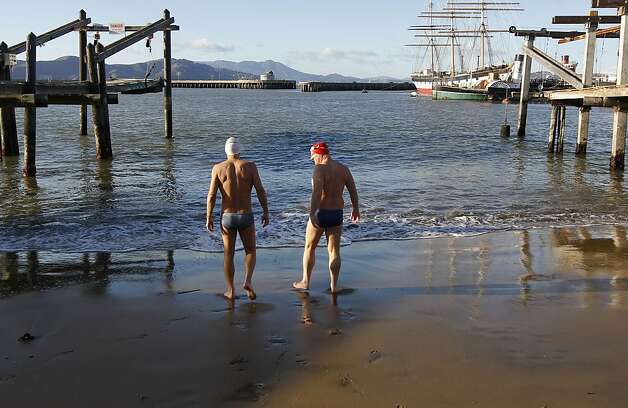
Steve Schatz (left) and Dr. Thomas Nuckton prepare for an afternoon swim off San Francisco's Aquatic Park last week. Both men are members of the Dolphin Club, which encourages swimming without wet suits. Photo: Michael Macor, The Chronicle
Last week, the Bay Area was quivering through a cold snap, and the tourists along Fisherman's Wharf were, for once, dressed for the weather, bundled in jackets and scarves, mittens and caps.
Down at Aquatic Park, Dr. Thomas Nuckton was stripped to his swimsuit and neck deep in 50-degree bay water. And he wasn't alone. Winter is the time of year that the truly devoted - or truly crazy - swimmers come out, those hardy folk who dive nearly naked into San Francisco Bay, into waters 25 or 30 degrees colder than the average swimming pool. The health benefits of these swims are debatable, the risks less so. And yet every year, dozens, maybe a hundred, people swim all through the winter months, putting in miles and hours in the water. "People will go down there to swim, and it's almost like a spiritual experience," Nuckton said. "It's not quite the same for me. I hate getting in the water," he added with a laugh. "But I have my good days. And I'd much rather be there than in a pool, staring at a black line and just going back and forth." Nuckton is a doctor at UCSF and California Pacific Medical Center, focused primarily on studying survival prognoses for patients in intensive care wards. But he's taken a side interest in swimming and, in particular, the effects of cold-water dips.

Last month, after a yearlong study of people in his swimming club, Nuckton was able to show that these swimmers are, in fact, just about the same size as the average American. Crazier, maybe. But not fatter.

"All of these factors probably come into play," Nuckton said. "How good is your engine in terms of generating heat? How cold is the water and how long are you going to spend in it?"

Schatz (left) and Nuckton brave the bay waters. Nuckton, a physician, has been studying his fellow cold-water swimmers. Photo: Michael Macor, The Chronicle
Aided by extra fat? More fit, but why? Risks overstated Peril of sudden shock

Nuckton's most recent study was prompted by a comment he overheard from a tourist standing on the Hyde Street Pier, watching the Aquatic Park swimmers. "He pointed at the swimmers and said, 'They're fatter than us. That's how they endure the cold,' " Nuckton recalled.

There is no doubt, doctors say, that regular cold-water swimmers are healthier overall than most Americans. But whether it's the cold or the simple act of regular exercise that helps them is unclear.

Over the past decade, Nuckton has made a hobby of studying the members of his swim group, the Dolphin Club. Along with the South End Rowing Club, the Dolphin Club encourages no-wet-suit swimming in the bay. The clubs' members host several group events year-round, including a New Year's Day swim from Alcatraz to Aquatic Park, and they operate hot showers and saunas for post-swim recovery.

"I'm not convinced that, physiologically speaking, cold-water swimming helps. I think these people are already healthy to begin with and they want to challenge their bodies," said Dr. Malini Singh, medical director of emergency medicine at San Francisco General HospitalThere are theories, but not much evidence, about how cold water can improve health. Some studies have shown that people who swim through the winter have higher immune cell counts than nonswimmers. And some scientists, and swimmers, have speculated that cold-water swimming increases production of what's known as brown fat, thought to be a healthy fat that burns energy and creates heat. Many cold-water swimmers believe they're burning more calories in the bay as their bodies struggle to stay warm than they would in a heated pool, but scientists aren't convinced that's the case. Cold water, in fact, slows the metabolism, which may mean that the body is actually burning fewer calories. Even if there is a larger calorie burn, it's probably negligible, doctors say.

It's not just the benefits of cold-water swimming that are tough to document. The risks are poorly understood and probably overstated too, some doctors said. Two studies of athletes competing in long-distance, open-water swims found that most of them were suffering mild hypothermia by the end of the race, even when the water temperatures were in the 60s or higher. "I know people do it. Anecdotally speaking, they say they feel refreshed, they feel less stress and less fatigue," she added. "But I've been in that water, in a wet suit, and I just felt terribly cold to my bones." Nuckton studied 11 participants in a 2000 Alcatraz swim and found that five were suffering mild hypothermia by the end of the event. And perhaps more concerning, their temperatures continued to drop after they got out of the water. But mild hypothermia on its own is not necessarily a dangerous thing. In Nuckton's study, most swimmers' temperatures dropped about 2 degrees below normal, which probably wouldn't produce any noticeable symptoms or discomfort. In order for hypothermia to cause major damage or become deadly, the body temperature needs to drop to the low 90s.

The concern with hypothermia is twofold. First, that someone may experience early symptoms of it and become sluggish or disoriented, which could be deadly when a swimmer is in deep water and has trouble making it safely back to land. And second, some older or less fit swimmers may not be as well adapted to handling the cold as their younger or more experienced peers.
"The important thing is, I wouldn't be doing this for the first time, just jumping right in, if you're elderly or have significant medical issues," said Dr. Joel Levis, assistant chief for the emergency department at Kaiser Santa Clara. "Those people are better off just swimming in a pool."

Aside from hypothermia, there is a small risk associated with the sudden shock of jumping into cold water. Anyone who has dived into frigid water knows the feeling - the heart rate soars, breathing becomes erratic, and it usually takes a minute or two to calm down. That's rarely a problem, but there have been a handful of cases of people suffering heart attacks and subsequently drowning from that initial shock.
And then there's the native aquatic life. For the most part, swimmers exist companionably with the critters, but several years ago a rogue sea lion bit dozens of people in Aquatic Park, requiring a few of them to get stitches and antibiotics.
But on the whole, a swimmer is probably more likely to be injured by someone doing a sloppy butterfly stroke at the pool than by, say, a great white shark in the open water.
"The chances of getting eaten by a shark are pretty low. You just don't think about it," said Robin Rose, an Aptos resident who swims regularly in Santa Cruz, usually doing a mile around the wharf several times a week.

Rose started open-water swimming in 2009, and she swam regularly even through treatment for breast cancer in 2010. She wears a wet suit for now - but she's seriously considering joining the "skin" swimmers sometime in the near future.
"I went to Aquatic Park, just to try it, and it actually felt really good," Rose said. "I was only in for about five minutes, and it was so cold, but it was so invigorating. There's nothing else like it."

Article Reprinted from: Erin Allday is a San Francisco Chronicle staff writer. E-mail: eallday@sfchronicle.com